
A first-timer’s guide to Brazil
The first thing you notice in Brasília is the light. It’s that dry cerrado light, sharp and golden, bouncing off the white curves of Oscar Niemeyer’s buildings. I’m writing this from my apartment in Asa Sul, where the superquadras are so quiet you can hear the parakeets. You’re probably planning your first trip to Brazil, and you’ve read a thousand generic guides that tell you about Rio’s beaches and São Paulo’s traffic. But Brazil is a continent, not a country, and the capital—this improbable airplane-shaped city in the middle of the savanna—is where you’ll understand the country’s soul. This guide is the one I wish someone had handed me before I moved here.
When to come (and how long to stay)
Forget the cliché of “always summer.” Brasília sits at 1,100 meters on the Central Plateau, so the weather is oddly temperate. The dry season (May to September) is your best bet: clear skies, 17–30°C, and humidity that doesn’t make you feel like you’re swimming. I’m writing this on August 19, and today’s forecast is exactly that—clear, 17 to 30 degrees, with sunrise at 06:26 and sunset at 18:04. The city glows in that light. If you come in the rainy season (October to March), expect afternoon downpours that turn the cerrado emerald but can flood the Monumental Axis.
How long should you stay? If you only have a week, don’t try to do Rio, the Amazon, and Brasília. You’ll spend half your time in airports. Give Brasília three to four full days: two for the landmarks, one for the parks and lake, and one to just wander and eat. If you’re combining with Rio or the Pantanal, budget at least ten days total—Brazil is huge, and internal flights eat a day each way. And if you can time your visit around a holiday, do it. September 7 is Independence Day (Dia da Independência), and in 2026 it falls on a Monday—perfect long weekend. The Esplanada dos Ministérios fills with people, there’s a military parade, and the city feels alive. Just book hotels early (try the Kubitschek Plaza Hotel or Tryp by Wyndham near the tourist core).
Getting around: metro, buses, and the magic of ride-hailing
Brasília was designed for cars, not pedestrians. The Plano Piloto is laid out like an airplane, with the Monumental Axis as the fuselage and the Asa Sul and Asa Norte wings as the cabins. Distances are deceptive—things look close on a map but are kilometers apart. Your two best friends are the Metrô-DF and Uber/99.
The metro is a Y-shaped line that runs from the center into the satellite cities (Águas Claras, Samambaia). It’s clean, cheap, and air-conditioned. You’ll need the Cartão DF rechargeable card, and the Bilhete Único integration lets you switch from bus to metro with a single fare—download the DFTrans or Moovit app to plan. But warning: the metro shuts down around midnight, and after that, you’re relying on ride-hailing. Uber and 99 are ubiquitous, and in the Plano Piloto you rarely wait more than five minutes. Nighttime in the wings is safe enough, but I always tell first-timers to take an Uber after dark if you’re not on a main avenue. The satellite cities (like Taguatinga, which is older than Brasília itself) are where most of the Federal District actually lives—authentic, working-class, and worth a day trip for the street food—but don’t wander there late at night without a local.
Money: reals, Pix, and what things cost
Brazil’s currency is the real (BRL), and the exchange rate is roughly 5.4 reals per US dollar. As of 2024, inflation was about 5%, so prices are creeping up, but Brasília remains a strange mix: expensive housing, cheap food. A modest one-bedroom flat in the city center runs about R$2,500 (around $460) per month—if you’re staying longer, that’s your baseline. Outside the center, it drops to R$1,400 (about $260). But eating out is a bargain.
Lunch is the great Brazilian equalizer. The comida por quilo (pay-by-weight) buffet is everywhere—you’ll find one at any shopping mall or business street. A filling plate with rice, beans, grilled meat, and salad will cost you R$20–40 (about $6). If you want a step up, a business-district set lunch with a drink is around R$51 (about $9). Dinner at a mid-range restaurant—think a nice pasta at Nonna Augusta Trattoria in Asa Norte or a steak at Vasto Restaurante 108 Sul—will run R$60–100 (about $15). Groceries are also reasonable: a liter of milk is about R$5.60, a day’s bread for two is R$5.70, and a half-liter of beer at the supermarket is R$8. The local street snacks are where you’ll feast like a king for pocket change: a pamonha (grilled corn cake, sweet or savory) at the Feira do Guará costs R$8–15, a beirute sandwich (oversized beef, cheese, egg on pita) at a Bar like Beirute is R$35–50, and a pastel (crispy fried pastry) with sugarcane juice is R$10–18.
One crucial tip: get a CPF (Cadastro de Pessoa Física) as soon as you land. It’s your Brazilian tax ID, and you need it for everything—a phone SIM, opening a bank account, even some hotel reservations. You can get it at a Receita Federal office or online. With a CPF and your passport, you can open a bank account at Banco do Brasil, Caixa, Itaú, Bradesco, or Santander, or go digital with Nubank or Inter (whose HQ is right here in Brasília). And once you have a bank account, you’ll use Pix—Brazil’s instant payment system—for everything. It’s faster than a credit card, and even street vendors have a QR code. Trust me, you’ll wonder why your country doesn’t have it.
What to see (beyond the obvious)
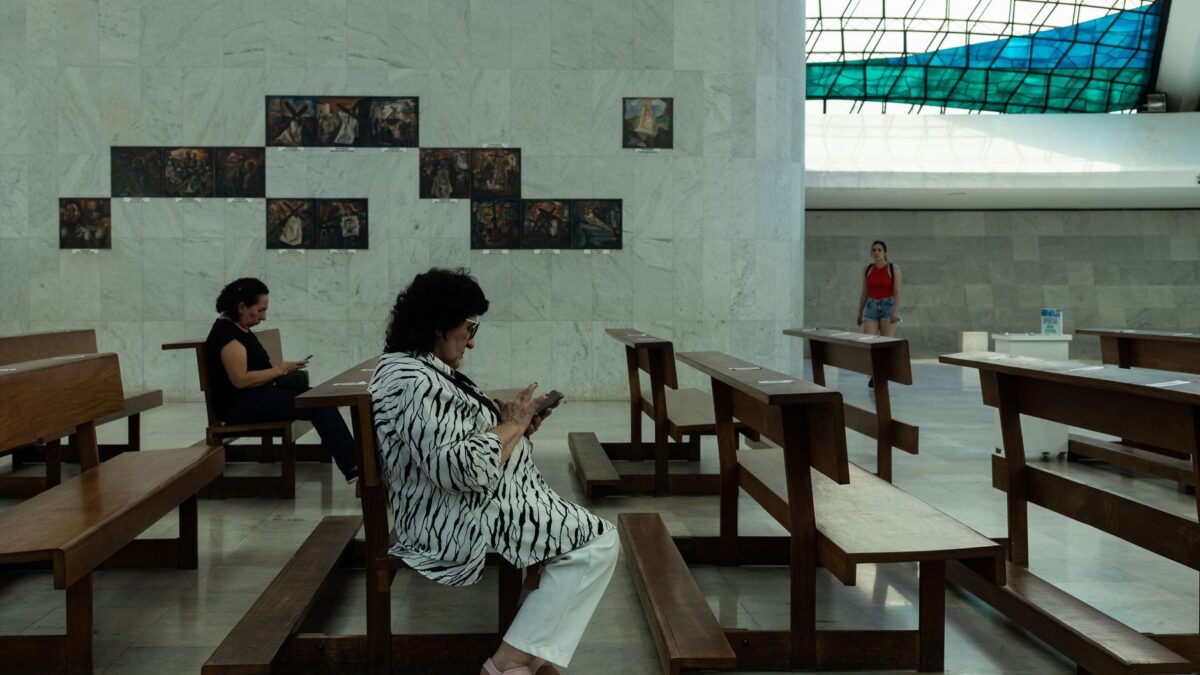
Yes, you must see the Catedral Metropolitana de Brasília—Niemeyer’s hyperboloid glass crown with its 16 curved columns and stained-glass interior. It’s the city’s icon. You should also visit Praça dos Três Poderes, the political heart, where the Palácio do Planalto (president’s office), the twin-towered Congresso Nacional, and the Supremo Tribunal Federal face each other. And don’t miss the Memorial JK, the museum and mausoleum of Juscelino Kubitschek, the president who built this city in under four years—it feels like a time capsule of 1960s optimism.
But the Brasília I love is in the details. Go to the Torre de TV for the best panoramic view of the airplane layout, then browse the artisan craft market (Feira da Torre) at its base. Spend a lazy afternoon at Parque da Cidade Sarah Kubitschek—it’s bigger than New York’s Central Park, and on weekends the ipê trees are full of toucans and macaws. For sunset, head to Pontão do Lago Sul, the lakeside restaurant complex on Lago Paranoá. Order a caipirinha at Sallva Bar e Ristorante, watch the capybaras graze along the shore, and see the JK Bridge light up.
Each district has its own personality. Asa Sul is the upscale South Wing—embassies, politicians, the CLSW restaurant strip. Asa Norte is younger, home to the University of Brasília (UnB) and a bohemian, LGBT-friendly bar scene; check out Ernesto Specialty Coffees or Los Baristas Coffee House for a caffeine fix. Lago Sul is the wealthiest enclave—gated mansions along the lake—but the Pontão is open to all. Lago Norte is quieter, near the Parque Nacional de Brasília (called Água Mineral), where you can swim in natural pools. And if you want to see where the real Federal District lives, take the metro to Taguatinga—it was founded before Brasília itself, and its streets are a riot of working-class commerce.
Practical things nobody tells you
First, visas: if you’re from the US, Canada, most of Western Europe, or the UK, you don’t need a visa for tourism up to 90 days (renewable once). Just carry a passport valid for your stay and a return ticket. But some nationalities—China, India—require an e-visa, so check with your consulate before booking anything.
Second, your phone. Buy a prepaid SIM (chip pré-pago) at a carrier store—Vivo, Claro, TIM, or Oi—in any shopping mall. Bring your passport and CPF to register. You’ll get 5G coverage in the Plano Piloto, and you can tether your laptop easily.
Third, safety. Let me be honest: the Plano Piloto wings (Asa Sul, Asa Norte, Lago Sul, Lago Norte) are safe and walkable by day. At night, keep to well-lit areas and use ride-hailing. The metro corridor into satellite cities and quiet streets late at night carry the usual big-city cautions. Use common sense—don’t flash a phone on a bus—and you’ll be fine. In 2026, Brasília is a city of 2.2 million in the Federal District, with a GDP per capita around $10,713—it’s not a poverty-stricken capital, but inequality is visible. Treat people with respect, and they’ll return it tenfold.
Finally, don’t skip the cerrado. This is the world’s most biodiverse savanna, and it surrounds the city. At Parque Nacional de Brasília, you can swim in the Água Mineral pools. On the lake, you’ll see capybaras, toucans, and macaws. If you’re lucky, you might spot a maned wolf or giant anteater in the reserves. This is the flip side of the concrete monumentalism—a city built in 41 months, inaugurated on 21 April 1960, with “fifty years of progress in five,” that somehow sits lightly within this ancient landscape.
Come with time, come with an appetite, and come with an open mind. Brasília will surprise you. It’s not just a political company town—it’s a place where rock bands like Legião Urbana were born, where modern cuisine mixes churrasco with cerrado fruits, and where the sunsets over Lago Paranoá are free. Boa viagem.
Frequently asked questions
What is the best time to visit Brasília, Brazil?
The dry season from May to September offers clear skies and mild temperatures (17–30°C). September 7 is Independence Day, a good time to see the city celebrate.
Do I need a visa to visit Brazil from the US or UK?
No, citizens of the US, UK, Canada, and most Western European countries enter visa-free for tourism up to 90 days, renewable once. Ensure your passport is valid for your stay.
How much does a typical lunch cost in Brasília?
A per-kilo lunch (comida por quilo) costs between R$20 and R$40 (about $6), while a business-district set lunch with a drink is around R$51 (about $9).
What is the best way to get around Brasília?
Use the Metrô-DF with the Cartão DF card for day trips, but after midnight rely on Uber or 99. The metro stops around midnight.
Is Brasília safe for first-time tourists?
The Plano Piloto areas (Asa Sul, Asa Norte, Lago Sul) are safe by day. At night, stick to well-lit spots and use ride-hailing. Avoid empty metro corridors late at night.


