

Vietnam in October 2026: what travelers should know now
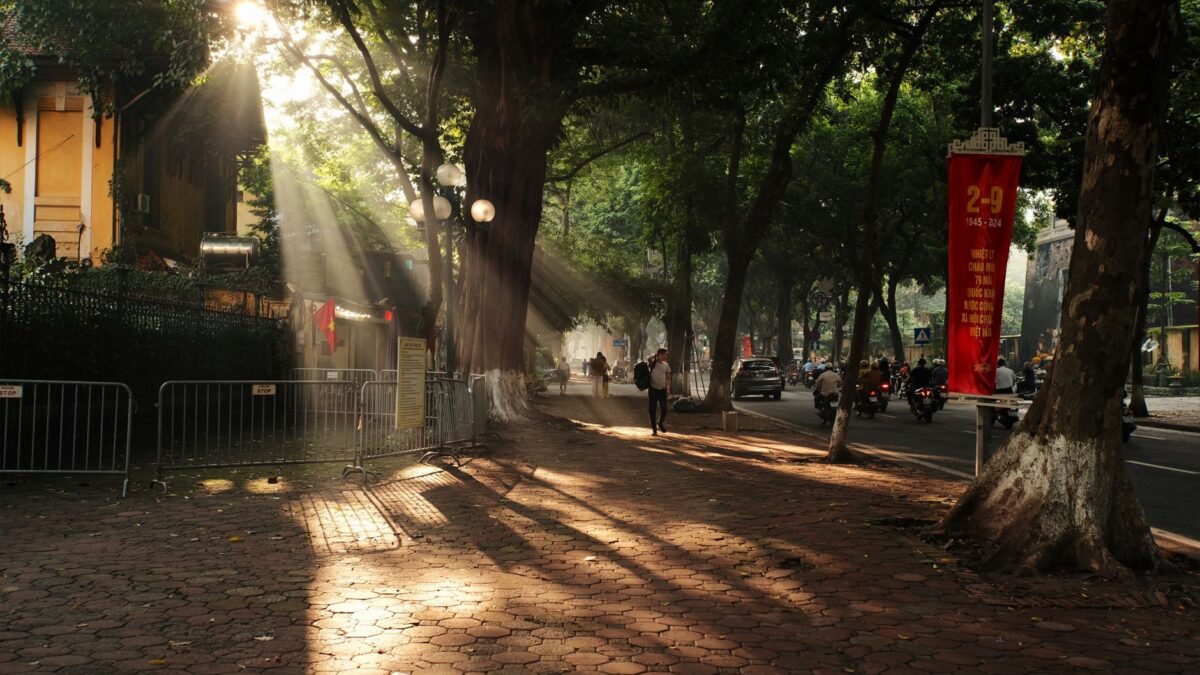
The sticky humidity of the wet season is finally breaking in Hanoi. As of today, October 2, the air has shifted into that crisp, early autumn clarity I love so much. Mornings are cooler, evenings bring a breeze through the banyan trees, and the streets are suddenly heavy with the scent of roasting young green rice (com) and milkflower (hoa sua). It is a sensory reset for anyone who has endured the summer heat. If you are arriving this month, you are catching the city at its most transitional and pleasant, but there are specific logistics to navigate right now.
Weather: Heat Lingers, But Autumn Is Coming
Do not let the calendar fool you into packing only light layers. The verified forecast for Hanoi right now shows temperatures between 27°C and 35°C, but with a “feels like” index hitting 40°C due to residual humidity and trapped heat. There are also scattered thunderstorms on the horizon—expect about 2mm of rain over a seven-hour window, typical of late-season downpours that pass quickly but heavily.
Pack for volatility. You need breathable linen or cotton for the midday sun, which still feels tropical, but bring a light jacket or cardigan for the evenings when the temperature drops noticeably. Waterproof shoes or sandals with good grip are essential because the pavement gets slick during those sudden afternoon bursts. If you stay out past sunset, the relief is real; the oppressive stickiness vanishes, replaced by a gentle coolness that makes walking around Hoan Kiem Lake genuinely enjoyable.
October Events: Crowds, Closures, and Construction
This week is unusually busy in central Hanoi. From October 1-4, two major events are converging on the Old Quarter. First, the 2nd World Cultural Festival is taking over the Thang Long Imperial Citadel. It features 50 countries, 45 cultural spaces, food stalls, and nightly concerts. The highlight is the ‘Colours of the Five Continents’ costume parade on October 3 at 16:00, which moves through the Hoan Kiem Lake pedestrian street. Second, the 11th Hanoi Book Fair is occupying the Hoan Kiem Lake pedestrian zone along Dinh Tien Hoang and Le Thai To streets. With dozens of publishers and hundreds of stalls, expect that stretch of the walking street to be completely closed off to vehicles and crowded with visitors until the opening ceremony evening of October 2.
If you plan to drive or use a motorbike taxi (xe om) near the lake center on October 4, beware. The Techcombank Hanoi International Marathon runs through the city centre that morning, bringing significant road closures and traffic diversions. Plan your route around it, or simply enjoy the energy from the sidelines.
Visually, you will also notice construction activity. Conservation work has begun on the Kinh Thien Palace (Dien Kinh Thien) at the Thang Long Imperial Citadel—the first phase of a long-term reconstruction. Additionally, Hoan Kiem ward is building a raised walkway with lighting around the lake, and the city is testing automatic vehicle-blocking posts for the pedestrian street. These works cause visible disruptions and temporary changes to foot traffic patterns around the lake, so keep an eye on local signage if you are navigating on two wheels.
Costs and Living: Food is Cheap, Rent is Rising
Hanoi remains one of the most affordable cities in Southeast Asia for daily sustenance, though housing costs are shifting. A full day of local eating can easily stay under 200,000 VND ($8.30). For breakfast, a bowl of pho bo at a local stall costs about 50,000–80,000 VND ($2.70). Lunch is where you find value: bun cha (grilled pork with vermicelli) is roughly 45,000–70,000 VND ($2.40), and a banh mi from a street cart is just 15,000–35,000 VND ($1.00). For dinner, a meal at an inexpensive street stall in the Old Quarter averages 40,000–80,000 VND ($2.50), while a mid-range restaurant meal runs 150,000–400,000 VND ($11).
Don’t miss the egg coffee (ca phe trung); it costs 25,000–45,000 VND ($1.40) and is worth every dong. And for evening wind-downs, a glass of bia hoi (fresh draft beer) at a street corner table is only 7,000–15,000 VND ($0.50). Transport is equally cheap: a single city bus fare is 7,000–9,000 VND ($0.30), and a monthly pass is 280,000 VND ($12).
However, if you are looking for long-term accommodation, prices have climbed. A modest one-bedroom flat in central districts now rents for 10,000,000–15,000,000 VND ($520), up roughly 10–15% year-on-year. Almost nothing below 10 million VND exists in the core areas anymore. Hotel rates and taxi base fares are harder to pin down precisely without recent data, but budgeting for meals and transit will leave you with plenty of room for savings.
Practicalities: Visas, Safety, and Daily Life
Entry requirements have tightened slightly. Most visitors use the 90-day Vietnam e-visa (US$25 single-entry / US$50 multiple-entry), applied online at evisa.gov.vn. Processing takes 3–5 working days. Crucially, since April 15, 2026, arrivals at major hubs must file a Digital Arrival Card via prearrival.immigration.gov.vn within 72 hours of arrival. You must enter through the specific port named on your visa (e.g., Noi Bai/HAN).
Once here, temporary residence registration is mandatory. Under Circular 87/2026/TT-BCA (effective July 24, 2026), your host (hotel, landlord, or serviced apartment) must declare your stay through the Ministry of Public Security’s electronic system at tbltkbtt.bocongan.gov.vn. This is free and available 24/7. In urban areas, you have 12 hours after arrival to complete this; remote areas allow 24 hours. Fines for failing to declare range from 3–20 million VND. Re-declaration is required every time you move or re-enter the country.
Safety-wise, Hanoi is generally safe, but pickpocketing and snatch-theft are prevalent in the Hoan Kiem/Old Quarter area. Keep phones off street-side tables at bars like those on Ta Hien Street, and watch scooters closely when crossing roads. Air quality is currently fine, but remember that November–February often brings unhealthy levels, so residents buy purifiers as winter approaches.
For connectivity, grab a prepaid SIM from Viettel, Mobifone, or Vinaphone at Noi Bai airport. You need your passport for registration. These carriers offer the best nationwide coverage. For banking, expats commonly use Vietcombank, Techcombank, BIDV, VPBank, ACB, or TPBank. Opening an account usually requires a passport, valid visa, and often proof of residence or work. Exchange rates are typically quoted from Vietcombank at around 26,000 VND/USD in mid-2026.
Where to Go: Districts and Landmarks
Navigate Hanoi by district to understand its rhythm. Hoan Kiem is the historic heart, home to the 1,000-year-old ’36 guild streets,’ Hoan Kiem Lake, and the French Quarter’s Opera House. Ba Dinh is the political center—quieter, leafy, and dominated by the Ho Chi Minh Mausoleum, Presidential Palace, and One Pillar Pagoda. Tay Ho (West Lake) is the expat and digital-nomad hub, with Western cafes along Xuan Dieu and Quang An streets, plus Tran Quoc Pagoda. Hai Ba Trung offers fashionable nightlife south of Hoan Kiem, while Dong Da is more residential, featuring the Temple of Literature and Train Street.
If you want to eat well, try Hoang’s Restaurant for Vietnamese and vegan options, or Hong Hoai’s Restaurant for classic flavors. For coffee, Hidden Gem Cafe Hanoi and Dream Beans Coffee Roastery are excellent spots to work or relax. Accommodations range from the Madelise Adora Hotel & Travel to the May De Ville Lakeside Hotel, depending on your budget and preferred vibe. If you need cash or banking services, Shinhan Bank and Woori Bank have branches in Hoan Kiem, alongside TPBank Hoàn Kiếm.
Enjoy the shift in seasons. The com is sweet, the nights are cool, and the city is alive with culture. Just watch your step across the streets and declare your stay promptly.
Frequently asked questions
Do I need a Digital Arrival Card for Vietnam in October 2026?
Yes. Since April 15, 2026, all arrivals at major hubs must file a Digital Arrival Card via prearrival.immigration.gov.vn within 72 hours before arrival.
What major events are happening in Hanoi this week?
The 2nd World Cultural Festival and the 11th Hanoi Book Fair run October 1-4 at the Thang Long Imperial Citadel and Hoan Kiem Lake area, respectively. The International Marathon is on October 4.
How do I register my temporary residence in Hanoi?
Your host must declare your stay via the Ministry of Public Security system (tbltkbtt.bocongan.gov.vn) within 12 hours of arrival in urban areas. Failure to do so incurs fines of 3–20 million VND.
Is it safe to drink tap water in Hanoi?
No. Tap water is not potable. Drink bottled or filtered water. Stick to sealed beverages or ice from reputable establishments to avoid stomach issues.
What is the best way to get around Hanoi?
Use Grab for door-to-door trips. The metro (Lines 2A and 3) is growing but limited. Buses are cheap (7,000–9,000 VND) but don't cover the whole city efficiently yet.
Things to do in Vietnam
 Likely to sell out
Number one top rated ethical cultural trekking and homestay by ETHOS
Likely to sell out
Number one top rated ethical cultural trekking and homestay by ETHOS
 Hanoi Motorbike Tour: Hanoi HIGHTLIGHTS & HIDDEN GEMS
 Da Nang Authentic Home Cooking Class
 Ho Chi Minh/Saigon Zero Tourist Food Tour
 The Central Highlands Explorer Loop
 Eat Like a Local: Saigon Michelin-selected Street Food by scooter