

What to eat in Vietnam — and what it costs
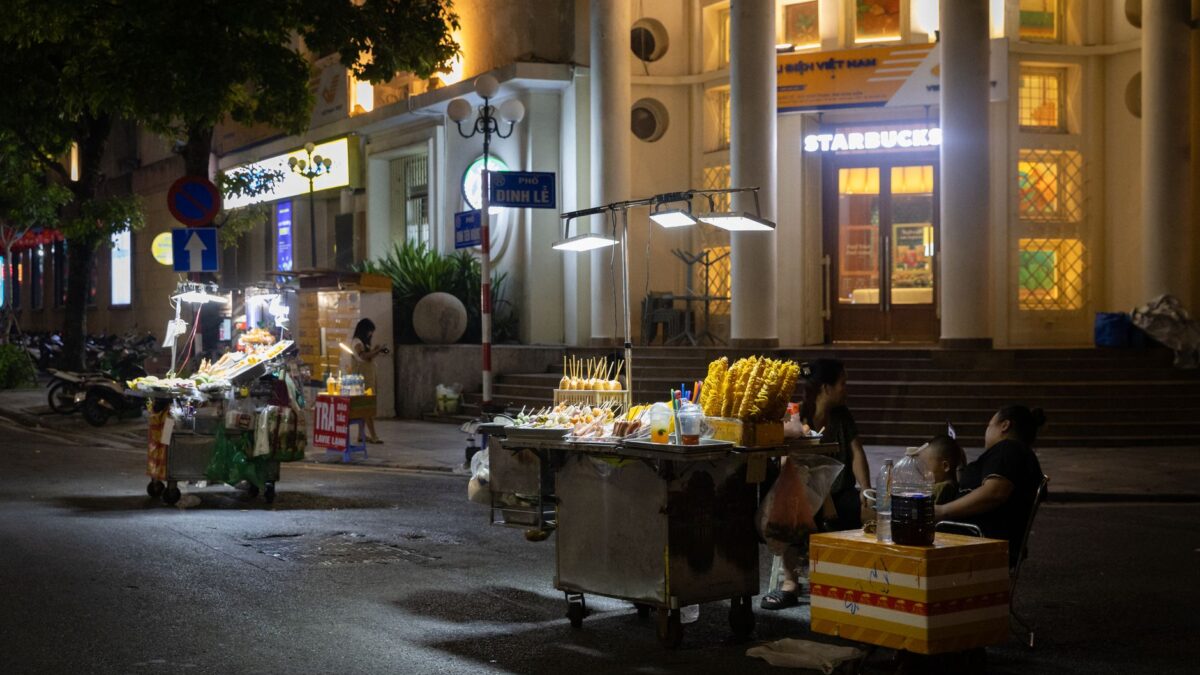
The air in Hanoi has turned. It’s still 27–35°C and the drizzle of a late summer afternoon makes the streets shimmer, but there’s a shift — a coolness that creeps in after dark, the first hint of autumn. That means one thing on every local’s mind: cốm, young green sticky rice, is coming into season. Mooncake stalls are already popping up on corners of the Old Quarter, paper lanterns swaying, lion-dance toys stacked high ahead of the Mid-Autumn full moon. This is the best time to eat in Vietnam’s capital — not just because of the seasonal treats, but because the streets are alive with the rhythms of a city about to celebrate its most delicious month.
Where to Start: The Old Quarter’s 36 Streets
If you’re new to Hanoi, the Old Quarter (Hoan Kiem district) is where you’ll want to spend your first day — and your first meals. The grid of 36 ancient guild streets — Hang Gai for silk, Hang Ma for paper — still hums with vendors and motorbikes, and every alley hides a food cart worth your while. Start early, because breakfast here is a ritual.
Grab a plastic stool at any busy phở stall on Hang Hanh or Lo Duc. A bowl of beef noodle soup with a clear, fragrant broth, soft rice noodles, and a side of herbs will cost you about 40,000 VND (roughly $1.7). In the Hoan Kiem tourist zone, expect up to 50,000–55,000 VND — still a bargain. Prices have crept up 15–20% through 2025, so if you see 45,000, that’s normal. It’s the beef and ingredient costs, but a humble meal is still under 100,000 VND.
Don’t leave the quarter without a Vietnamese coffee stop. Head to Hidden Gem Cafe Hanoi or Hanoi Coffee Culture — both are real, local favorites. A cà phê sữa đá (iced coffee with condensed milk) will set you back about 25,000–35,000 VND. For the famous egg coffee, the legend is Café Giang near Hoan Kiem Lake — rich, custardy, and unlike anything else.
Street Food Staples: From Bánh Mì to Bún Chả
The street food scene is the heart of Hanoi. You can eat well for less than a dollar at breakfast, and a full sit-down meal rarely exceeds 70,000 VND.
- Bánh mì — a crusty baguette stuffed with pâté, egg, pickled carrots, and fresh herbs. At a street stall, it’s about 25,000 VND (basic) to 35,000–50,000 if fully loaded. Find a cart with a line — they’re always the best.
- Xôi xéo — turmeric sticky rice with mung bean and fried shallots, a classic street breakfast. A warm plastic-wrapped pack costs 20,000 VND (15,000–25,000). Grab one near a bus stop or in the Dong Xuan market area.
- Bánh cuốn — steamed rice rolls filled with pork and mushroom, served with fried shallots and fish sauce. At a morning stall in the Old Quarter or near the French Quarter, it’s about 30,000 VND.
- Bún chả — grilled pork patties with vermicelli noodles and a tangy dipping sauce. The most famous spot is Bún Chả Hương Liên on Le Van Huu Street, where President Obama ate — a lunch set there is around 50,000–65,000 VND. For a true local vibe, any tiny shop in the Old Quarter serves a set for 45,000–65,000.
After a morning of eating, you might want to walk it off around Hoan Kiem Lake — the symbol of the city with Turtle Tower and Ngoc Son Temple linked by the red Huc Bridge. On weekends, the pedestrian zone fills with families, performers, and more food carts.
Sit Down and Savor: Local Restaurants and French Quarter Charm
For a proper sit-down meal without breaking the bank, head to the quieter streets of the French Quarter (Hai Ba Trung district) or the charming lanes near Hoan Kiem. Restaurants like Hong Hoai’s Restaurant, Hanoi-Oi Kitchen, or Cái Mâm Restaurant are local favorites, serving home-style Vietnamese dishes in a relaxed setting. Expect to pay around 60,000–100,000 VND per person for a main dish, plus a drink — still a steal compared to any world capital.
For a signature Hanoi experience, try chả cá — turmeric-marinated fish grilled at your table with dill and shrimp paste. The most historic spot is Cha Ca La Vong on Cha Ca Street, a family-run restaurant that has been serving this dish for over a century. It’s a bit pricier, around 250,000–300,000 VND for a set, but worth the splurge.
In the evenings, join locals on Ta Hien “beer street” in the Old Quarter. A cold glass of bia hơi (fresh draft beer) costs about 10,000–15,000 VND, and you can nibble on fried peanuts or dried squid. It’s chaotic, loud, and utterly authentic.
Beyond the Center: Cau Giay, Tay Ho, and the Metro
If you have time, venture out of the tourist bubble. Cau Giay district is Hanoi’s tech corridor, full of students and young workers — which means cheap, quick eats. A bowl of phở here costs around 35,000–40,000 VND, and you’ll sit alongside office workers and university students. Tay Ho (West Lake) is the expat hub, known for bánh tôm (shrimp cakes) — crispy batter with whole shrimp, a West Lake specialty. Grab a plate at a stall along Quang An peninsula for about 50,000 VND.
Getting around is easy and cheap. A single bus ride costs about 7,000–9,000 VND (new distance-based fare: 3,000 VND base + 450 VND/km), and the metro (Line 2A and Line 3) runs at 8,000–15,000 VND per ride. Use the ‘Hanoi Metro’ app for QR tickets, or tap your Visa at the gates. If you’re staying a while, a monthly public-transport pass is about 280,000 VND for one line, or 500,000 for the multi-modal pass.
While in Cau Giay, don’t miss the Vietnam Museum of Ethnology — a superb introduction to Vietnam’s 54 ethnic groups, with traditional houses in the garden. It’s an easy metro ride away and a good break from eating (though the museum’s cafe also serves decent snacks).
Seasonal Bites and Festivals: Autumn in Hanoi
Right now, the streets are full of mooncake stalls for the Mid-Autumn Festival (Tet Trung Thu), which falls on the full moon in September. The Full Moon Festival market at 62 Trang Tien Street runs from August 14 to 16, with dozens of stalls selling mooncakes, to he figurines, paper lanterns, and toys. It’s a sensory overload — perfect for a evening stroll. A single mooncake (the size of your palm) costs about 30,000–50,000 VND; boxes for gifts run 200,000–500,000 VND.
The season also brings cốm — young green sticky rice that’s pressed, toasted, and often wrapped in banana leaves. It’s a delicate, nutty treat sold along Hang Than and in the Old Quarter. A portion is about 20,000 VND. Pair it with a banana or a slice of ripe persimmon — a classic autumn pairing.
If you’re in the city on September 2, it’s National Day (Quốc khánh) — a public holiday with parades and celebrations. Expect crowds at Ba Dinh Square and around Ho Chi Minh’s Mausoleum, but the street food will be even more generous.
Practical Bites: Navigating Hanoi’s Food Scene with Ease
Eating in Hanoi is safe, but a few tips will make your experience smoother:
- Pay with cash at most street stalls — small denominations are appreciated. For restaurants, VietQR payment is common; set up a local bank account at VPBank or Timo with just your passport and e-visa.
- Get a local SIM at Noi Bai Airport or a Viettel store (about 50,000–100,000 VND) so you have data for maps and translation. Registration requires your passport, but it’s worth it.
- Watch your phone — motorbike snatch-theft happens in the Old Quarter. Keep your phone off café tables and your bag on the inner side of the pavement.
- Drink the water? It’s best to stick to bottled or filtered water, but all hot tea and coffee are fine.
Hanoi’s food is a living atlas of its history — from French baguettes to imperial pho, from Chinese-inspired bánh cuốn to indigenous cốm. Prices remain absurdly low for the quality and depth of flavor. So come hungry, walk slow, and let the streets feed you. You’ll leave with a full stomach and a heart that’s already planning your return.
Frequently asked questions
How much does a bowl of pho cost in Hanoi in 2026?
A beef pho at a street stall is about 40,000 VND (roughly $1.7), with typical ranges of 35,000–45,000 VND. In the Hoan Kiem tourist area, it can be up to 50,000–55,000 VND.
What is the best local dish to eat in Hanoi during August?
Cốm (young green sticky rice) is just coming into season, and the Full Moon Festival market at 62 Trang Tien Street (Aug 14–16) is perfect for trying mooncakes and seasonal street food.
Is it safe to eat street food in Hanoi?
Yes, it’s generally safe. Look for stalls with high turnover and busy locals. Stick to bottled water, and avoid raw vegetables if you have a sensitive stomach.
How do I pay at street food stalls in Hanoi?
Cash is king at street stalls — carry small bills in VND. For restaurants, VietQR payment via bank apps like VPBank or Timo works if you’ve set up an account.


