

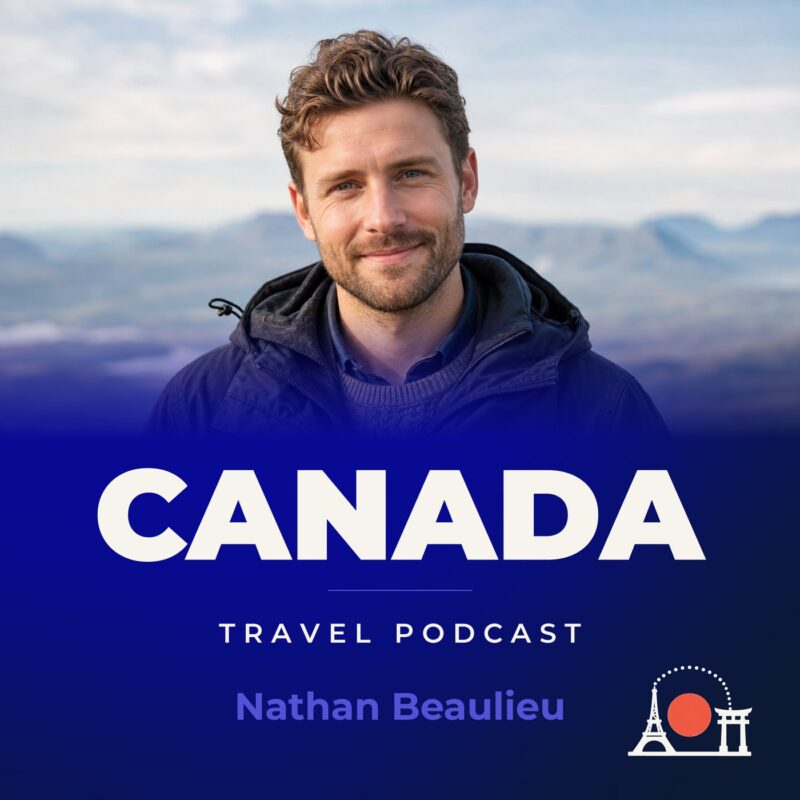
Canada Travel Podcast with Nathan Beaulieu
Hosted by Nathan Beaulieu — a new episode every day from Canada.
Travelling in Canada means learning to read distance differently. The country is enormous, and almost everyone lives in a narrow band close to the United States border, so the landscape shifts from city to empty boreal forest without warning. The show follows Nathan Beaulieu as he moves through this geography slowly, settling somewhere long enough to understand how that place actually works.
The host moves from the old port of Montreal to the river valley in Saskatoon, from the Rocky Mountain foothills near Calgary to the fishing stages of Bonavista, Newfoundland. He also spends time in Ottawa, the capital, where winter freezes the canal and summer brings a different kind of quiet. Each stop is connected by the route he takes to the next one.
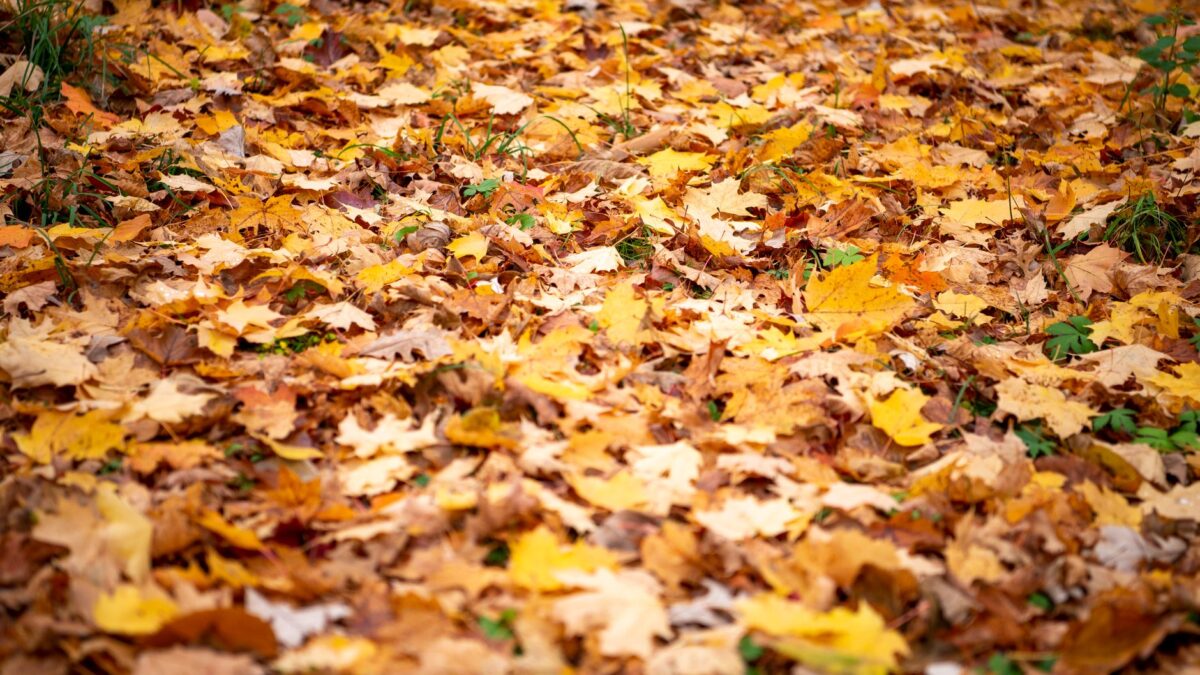
Seasons are the real clock. The same street in Ottawa appears under brown maple leaves and then under March slush, and a place he left in one state is a different place when he comes back. That slow return is how the show works: knowing somewhere properly takes months, not a stopover.
Recent episodes
Things to do in Canada
 Go Fundy Tours
 Tour of Niagara Falls (Niagara Falls)
 Special offer
Drumheller & Hoodoos Day Trip from Calgary, Explore the Badlands
Special offer
Drumheller & Hoodoos Day Trip from Calgary, Explore the Badlands
 Explore Lake Louise, Emerald Lake, Takakkaw & 3 National Parks
 Adrenaline Canyoning Tour Kelowna - Falls, Rappelling & Adventure
 Vancouver Sailing Experience on a 50 Foot Sailboat
 12 Iconic Stops: Banff & Yoho Premium Small Group Guided Tour
 Helicopter Tour Over Mont-Tremblant 70KM ( 20 min )
Plan your trip to Canada
Getting around
Staying connected
Canada at a glance
Canada in depth
Reference data on the country — geography, people, history, economy and transport.
Geography and climate
Location
Northern North America, bordering the North Atlantic Ocean on the east, North Pacific Ocean on the west, and the Arctic Ocean on the north, north of the conterminous US
Terrain
Mostly plains with mountains in west, lowlands in southeast
Climate
Varies from temperate in south to subarctic and arctic in north
Elevation
- Highest point
- Mount Logan 5,959 m
- Lowest point
- Atlantic/Pacific/Arctic Oceans 0 m
- Mean elevation
- 487 m
Area
- Total
- 9,984,670 sq km
- Land
- 9,093,507 sq km
- Water
- 891,163 sq km
Size comparison
Slightly larger than the US
Coastline
202,080 km
Land borders
- Total
- 8,892 km
- Border countries
- US 8,891 km (includes 2,475 km with Alaska); Denmark (Greenland) 1.3 km
Natural resources
Bauxite, iron ore, nickel, zinc, copper, gold, lead, uranium, rare earth elements, molybdenum, potash, diamonds, silver, fish, timber, wildlife, coal, petroleum, natural gas, hydropower
Land use
- Agricultural land
- 6.5% (2023 est.)
- Arable land
- 4.3% (2023 est.)
- Permanent crops
- 0% (2023 est.)
- Permanent pasture
- 2.1% (2023 est.)
- Forest
- 42% (2023 est.)
- Other
- 51.4% (2023 est.)
Natural hazards
Continuous permafrost in north is a serious obstacle to development; cyclonic storms form east of the Rocky Mountains, a result of the mixing of air masses from the Arctic, Pacific, and North American interior, and produce most of the country's rain and snow east of the mountains
Volcanism: the vast majority of volcanoes in Western Canada's Coast Mountains remain dormant
Note
Note 1: second-largest country in the world (after Russia) and largest in the Americas; strategic location between Russia and US via north polar route; approximately 90% of the population is concentrated within 160 km (100 mi) of the US border
Note 2: Canada has more fresh water than any other country, and almost 9% of Canadian territory is water; Canada has at least 2 million and possibly over 3 million lakes, more than all other countries combined
People and society
Population
- Total
- 39,187,155 (2025 est.)
- Male
- 19,515,416
- Female
- 19,671,739
Nationality
- Noun
- Canadian(s)
- Adjective
- Canadian
Ethnic groups
Canadian 15.6%, English 14.7%, Scottish 12.1%, French 11%, Irish 12.1%, German 8.1%, Chinese 4.7%, Italian 4.3%, First Nations 1.7%, Indian 3.7%, Ukrainian 3.5%, Metis 1.5% (2021 est.)
Languages
- Languages
- English (official) 87.1%, French (official) 29.1%, Chinese languages 4.2%, Spanish 3.2%, Punjabi 2.6%, Arabic 2.4%, Tagalog 2.3%, Italian 1.5% (2022 est.)
- Major-language sample(s)
- The World Factbook, the indispensable source for basic information. (English)
Religions
Christian 53.3%, Muslim 4.9%, Hindu 2.3%, Sikh 2.1%, Buddhist 1%, Jewish 0.9%, Traditional (North American Indigenous) 0.2%, other religions and traditional spirituality 0.6%, none 34.6% (2021 est.)
Median age
- Total
- 42.8 years (2025 est.)
- Male
- 41.4 years
- Female
- 43.8 years
Life expectancy
- Total population
- 84.2 years (2024 est.)
- Male
- 81.9 years
- Female
- 86.6 years
Urbanisation
- Urban population
- 81.9% of total population (2023)
- Rate of urbanization
- 0.95% annual rate of change (2020-25 est.)
Where people live
Vast majority of the population lives in a discontinuous band within approximately 300 km (186 mi) of the southern border with the United States; the most populated province is Ontario, followed by Quebec and British Columbia
Largest cities
6.372 million Toronto, 4.308 million Montreal, 2.657 million Vancouver, 1.640 million Calgary, 1.544 million Edmonton, 1.437 million OTTAWA (capital) (2023)
Background and government
Background
A land of vast distances and rich natural resources, Canada became a self-governing dominion in 1867, while retaining ties to the British crown. Canada gained legislative independence from Britain in 1931 and formalized its constitutional independence from the UK when it passed the Canada Act in 1982. Economically and technologically, the nation has developed in parallel with the US, its neighbor to the south across the world's longest international border. Canada faces the political challenges of meeting public demands for quality improvements in health care, education, social services, and economic competitiveness, as well as responding to the particular concerns of predominantly francophone Quebec. Canada also aims to develop its diverse energy resources while maintaining its commitment to the environment.
Government
Federal parliamentary democracy (Parliament of Canada) under a constitutional monarchy; a Commonwealth realm; federal and state authorities and responsibilities regulated in constitution
Capital
Ottawa
Time zone
UTC-5 (same time as Washington, DC, during Standard Time)
Independence
1 July 1867 (union of British North American colonies); 11 December 1931 (recognized by UK per Statute of Westminster)
National day
Canada Day, 1 July (1867)
Economy and cost of living
Overview
High-income economy and second-largest US trading partner; key timber, oil, and gas industries; trade uncertainties and weak business investments contributing to economic slowdown; high and growing public debt; inflation moderating but remains above target range
GDP per capita
- Real GDP per capita 2024
- $56,700 (2024 est.)
- Real GDP per capita 2023
- $57,500 (2023 est.)
- Real GDP per capita 2022
- $58,300 (2022 est.)
Inflation
- Inflation rate (consumer prices) 2024
- 2.4% (2024 est.)
- Inflation rate (consumer prices) 2023
- 3.9% (2023 est.)
- Inflation rate (consumer prices) 2022
- 6.8% (2022 est.)
Unemployment
- Unemployment rate 2024
- 6.5% (2024 est.)
- Unemployment rate 2023
- 5.5% (2023 est.)
- Unemployment rate 2022
- 5.3% (2022 est.)
Exchange rate
- Currency
- Canadian dollars (CAD) per US dollar -
- Exchange rates 2024
- 1.369 (2024 est.)
- Exchange rates 2023
- 1.35 (2023 est.)
- Exchange rates 2022
- 1.302 (2022 est.)
- Exchange rates 2021
- 1.254 (2021 est.)
- Exchange rates 2020
- 1.341 (2020 est.)
Main industries
Transportation equipment, chemicals, processed and unprocessed minerals, food products, wood and paper products, fish products, petroleum, natural gas
Agriculture
Wheat, rapeseed, maize, milk, barley, soybeans, potatoes, peas, oats, pork (2023)
Transport and connectivity
Airports
1,459 (2025)
Railways
- Total
- 49,422 km (2021) note: 129 km electrified (2021)
- Standard gauge
- 49,422 km (2021) 1.435-m gauge
Ports
- Total ports
- 284 (2024)
- Large
- 4
- Medium
- 14
- Small
- 58
- Very small
- 149
- Size unknown
- 59
- Ports with oil terminals
- 59
- Key ports
- Argentia, Canaport (St. John), Halifax, Hamilton, Montreal, New Westminster, Pond Inlet, Prince Rupert, Quebec, Sept Iles, St. John, Sydney, Thunder Bay, Toronto, Trois Rivieres, Vancouver, Victoria Harbor, Windsor
Internet domain
.ca
Internet users
Percent of population 94% (2023 est.)
Mobile subscriptions
- Total subscriptions
- 37.4 million (2024 est.)
- Subscriptions per 100 inhabitants
- 94 (2024 est.)
Environment
Environmental issues
Air pollution and acid rain from vehicle emissions, coal-burning, and metal smelting severely affecting lakes and forests; seawater pollution from agriculture, industry, mining, and forestry
Fresh water
2.902 trillion cubic meters (2022 est.)
UNESCO Global Geoparks
- Total global geoparks and regional networks
- 5
- Global geoparks and regional networks
- Perce; Stonehammer; Tumbler Ridge; Cliffs of Fundy; Discovery (2023)
Country reference figures are periodically revised. Check anything time-sensitive or safety-critical against an official source before you travel.
Canada travel guides
 News & Updates
Canada in September 2026: what travelers should know now
Canada travel briefing for September 2026: Weather, Labour Day events, transit updates, and safety tips for Ottawa.
 Food & Drink
What to eat in Canada — and what it costs
Discover what to eat in Ottawa, Canada—from Beavertails and shawarma to fine dining—with real prices and local spots, plus a festival guide.
 Costs & Money
How much does a trip to Canada cost?
Detailed Canada trip cost breakdown for Ottawa: accommodation, food, transit, attractions in CAD with daily budgets for budget, mid-range, and comfortable travel.
 News & Updates
Canada in August 2026: what travelers should know now
Canada in August 2026: Pride weekend in Ottawa, road closures, Labour Day plans, transit updates, and what things cost now.
North America
 United States
United States Travel Podcast with Harper Wells
Listeners join a resident's-eye journey through American terrain, from New York's urban cluster to Alaska's broad river valleys and the arid Great…
 Mexico
Mexico Travel Podcast with Valeria Cruz
The high plateau between Jalisco and Veracruz holds most of the country's population, and Mexico City alone accounts for a quarter.