

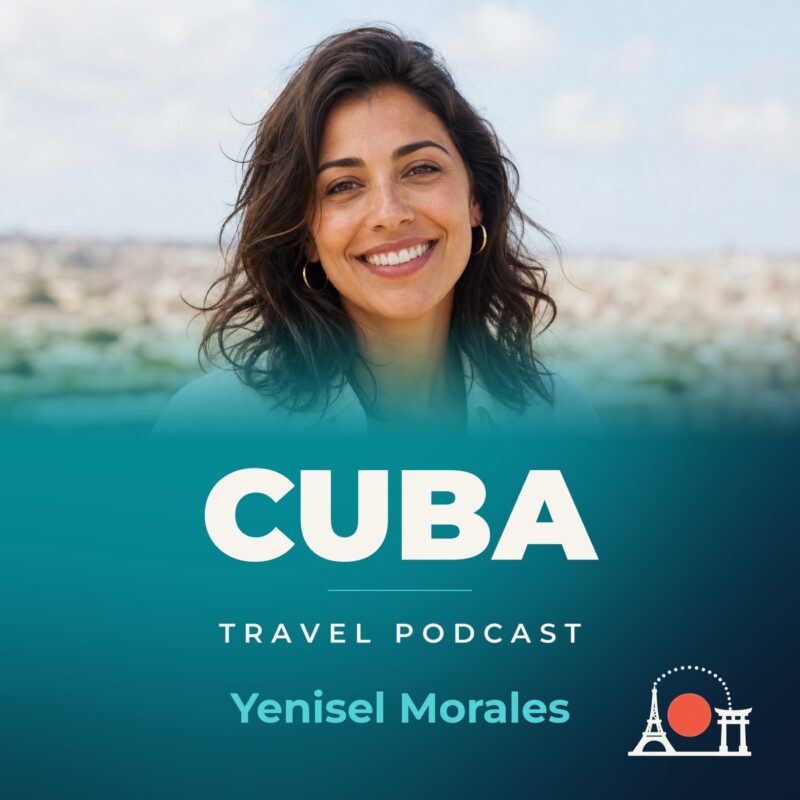
Cuba Travel Podcast with Yenisel Morales
Hosted by Yenisel Morales — a new episode every day from Cuba.
This podcast follows a single traveller settling in Cuba over a couple of years, learning how the island actually works. Cuba is the largest country in the Caribbean, with a tropical climate that splits the year into a dry season and a rainy season. That rhythm shapes everything from the colour of the hills to the pace of daily life.
Episodes range from Havana’s streets to the eastern mountains of the Sierra Maestra, the colonial centre of Camagüey and the coastal town of Baracoa. The focus is on the landscapes that give each region its character: flat plains, rolling farmland, and the rugged hills that rise in the southeast.
The series unfolds in real time: the dry season arriving in November, the rains returning in May, and the same places appearing again months later as the host goes back to them. That return is the point. Knowing a town in Cuba takes more than a single visit, and the show lets familiarity build by living through two full seasonal cycles.
Recent episodes
Plan your trip to Cuba
Getting around
Staying connected
Cuba at a glance
Cuba in depth
Reference data on the country — geography, people, history, economy and transport.
Geography and climate
Location
Caribbean, island between the Caribbean Sea and the North Atlantic Ocean, 150 km south of Key West, Florida
Terrain
Mostly flat to rolling plains, with rugged hills and mountains in the southeast
Climate
Tropical; moderated by trade winds; dry season (November to April); rainy season (May to October)
Elevation
- Highest point
- Pico Turquino 1,974 m
- Lowest point
- Caribbean Sea 0 m
- Mean elevation
- 108 m
Area
- Total
- 110,860 sq km
- Land
- 109,820 sq km
- Water
- 1,040 sq km
Size comparison
Slightly smaller than Pennsylvania
Coastline
3,735 km
Land borders
- Total
- 28.5 km
- Border countries
- US Naval Base at Guantanamo Bay 28.5 km
Natural resources
Cobalt, nickel, iron ore, chromium, copper, salt, timber, silica, petroleum, arable land
Land use
- Agricultural land
- 61.7% (2023 est.)
- Arable land
- 28% (2023 est.)
- Permanent crops
- 6.3% (2023 est.)
- Permanent pasture
- 27.4% (2023 est.)
- Forest
- 34.9% (2023 est.)
- Other
- 3.5% (2023 est.)
Natural hazards
The east coast is subject to hurricanes from August to November (in general, the country averages about one hurricane every other year); droughts are common
Note
Largest country in Caribbean and westernmost island of the Greater Antilles
People and society
Population
- Total
- 10,059,519 (2025 est.)
- Male
- 4,950,615
- Female
- 5,108,904
Nationality
- Noun
- Cuban(s)
- Adjective
- Cuban
Ethnic groups
White 64.1%, Mulatto or mixed 26.6%, Black 9.3% (2012 est.)
Languages
- Languages
- Spanish (official)
- Major-language sample(s)
- La Libreta Informativa del Mundo, la fuente indispensable de información básica. (Spanish)
Religions
Christian 58.9%, folk religion 17.6%, Buddhist <1%, Hindu <1%, Jewish <1%, Muslim <1%, other <1%, none 23.2% (2020 est.)
Median age
- Total
- 46.2 years (2025 est.)
- Male
- 41 years
- Female
- 44.4 years
Life expectancy
- Total population
- 80.1 years (2024 est.)
- Male
- 77.8 years
- Female
- 82.6 years
Urbanisation
- Urban population
- 77.5% of total population (2023)
- Rate of urbanization
- 0.19% annual rate of change (2020-25 est.)
Where people live
Large population clusters found throughout the country, the more significant ones being in the larger towns and cities, particularly the capital of Havana
Largest cities
2.149 million HAVANA (capital) (2023)
Background and government
Background
The native Amerindian population of Cuba began to decline after the arrival of Christopher COLUMBUS in 1492, as the country was developed as a Spanish colony during the next several centuries. Large numbers of African slaves were imported to work the coffee and sugar plantations, and Havana became the launching point for the annual treasure fleets bound for Spain from Mexico and Peru. Spanish rule eventually provoked an independence movement, and occasional rebellions were harshly suppressed. US intervention during the Spanish-American War in 1898 assisted the Cubans in overthrowing Spanish rule. The Treaty of Paris established Cuban independence from Spain in 1898, and after three-and-a-half years of subsequent US military rule, Cuba became an independent republic in 1902.
Cuba then experienced a string of governments mostly dominated by the military and corrupt politicians. Fidel CASTRO led a rebel army to victory in 1959; his authoritarian rule held the subsequent regime together for nearly five decades. He handed off the presidency to his younger brother Raul CASTRO in 2008. Cuba's communist revolution, with Soviet support, was exported throughout Latin America and Africa during the 1960s, 1970s, and 1980s. Miguel DIAZ-CANEL Bermudez, hand-picked by Raul CASTRO to succeed him, was approved as president by the National Assembly and took office in 2018. DIAZ-CANEL was appointed First Secretary of the Communist Party in 2021 after the retirement of Raul CASTRO and continues to serve as both president and first secretary. Cuba traditionally and consistently portrays the US embargo, in place since 1961, as the source of its socioeconomic difficulties. As a result of efforts begun in 2014 to reestablish diplomatic relations, the US and Cuba reopened embassies in their respective countries in 2015. The embargo remains in place, however, and the relationship between the US and Cuba remains tense. Illicit migration of Cuban nationals to the US via maritime and overland routes has been a longstanding challenge. In 2017, the US and Cuba signed a Joint Statement ending the so-called "wet-foot, dry-foot" policy, by which Cuban nationals who reached US soil were permitted to stay. Irregular Cuban maritime migration has dropped significantly since 2016, when migrant interdictions at sea topped 5,000, but land border crossings continue.
Government
Communist state
Capital
Havana
Time zone
UTC-5 (same time as Washington, DC, during Standard Time)
Local name
República de Cuba
Independence
20 May 1902 (from US administration); 10 December 1898 (from Spain); not acknowledged by the Cuban Government as days of independence
National day
Triumph of the Revolution (Liberation Day), 1 January (1959)
Economy and cost of living
Overview
Still largely state-run planned economy, although privatization increasing under new constitution; widespread protests due to lack of basic necessities and electricity; massive foreign investment increases recently; known tobacco exporter; unique oil-for-doctors relationship with Venezuela; widespread corruption
GDP per capita
- Real GDP per capita 2024
- $23,700 (2024 est.)
- Real GDP per capita 2023
- $18,300 (2023 est.)
- Real GDP per capita 2022
- $13,300 (2022 est.)
Inflation
- Inflation rate (consumer prices) 2022
- 76.1% (2022 est.)
- Inflation rate (consumer prices) 2021
- 151.9% (2021 est.)
- Inflation rate (consumer prices) 2020
- 11.9% (2020 est.)
Unemployment
- Unemployment rate 2024
- 1.6% (2024 est.)
- Unemployment rate 2023
- 1.8% (2023 est.)
- Unemployment rate 2022
- 1.9% (2022 est.)
Exchange rate
- Currency
- Cuban pesos (CUP) per US dollar -
- Exchange rates 2024
- 24 (2024 est.)
- Exchange rates 2023
- 24 (2023 est.)
- Exchange rates 2022
- 24 (2022 est.)
- Exchange rates 2021
- 24 (2021 est.)
- Exchange rates 2020
- 1 (2020 est.)
Main industries
Petroleum, nickel, cobalt, pharmaceuticals, tobacco, construction, steel, cement, agricultural machinery, sugar
Agriculture
Sugarcane, cassava, plantains, vegetables, mangoes/guavas, milk, tomatoes, pumpkins/squash, sweet potatoes, bananas (2023)
Transport and connectivity
Airports
120 (2025)
Railways
- Total
- 8,367 km (2017)
- Standard gauge
- 8,195 km (2017) 1.435-m gauge (124 km electrified)
- Narrow gauge
- 172 km (2017) 1.000-m gauge
Ports
- Total ports
- 34 (2024)
- Large
- 6
- Medium
- 3
- Small
- 10
- Very small
- 6
- Size unknown
- 9
- Ports with oil terminals
- 14
- Key ports
- Antilla, Bahai de la Habana, Bahia de Sagua de Tanamo, Cabanas, Casilda, Cienfuegos, Nuevitas Bay, Puerto Guantanamo, Santiago de Cuba
Internet domain
.cu
Internet users
Percent of population 71% (2023 est.)
Mobile subscriptions
- Total subscriptions
- 8.01 million (2024 est.)
- Subscriptions per 100 inhabitants
- 73 (2024 est.)
Environment
Environmental issues
Soil degradation and desertification (brought on by poor farming techniques and natural disasters); biodiversity loss; deforestation; air and water pollution
Fresh water
38.12 billion cubic meters (2022 est.)
Country reference figures are periodically revised. Check anything time-sensitive or safety-critical against an official source before you travel.
Cuba travel guides
 Getting Around
From the airport into Havana: every option and what it costs
Navigate Havana's airport transfers with real fares for taxis, buses, and private rides. Expert tips on costs, safety, and navigating Cuba's transport crisis.
 Living Abroad
Moving to Cuba: visas, banking and SIM cards
Moving to Cuba? Get practical first-week advice on visas, residency, bank accounts, SIM cards, and renting in Havana — from a local's perspective.
 Travel Tips
A first-timer’s guide to Cuba
Essential first-timer’s guide to Cuba: best time to visit, getting around, money, visas, and what to expect in 2026 — from a local in…
 News & Updates
Cuba in August 2026: what travelers should know now
A local's August 2026 Cuba travel briefing: heat, blackouts, rumba festivals, and navigating a two-tiered economy in Havana.
Caribbean
 Dominican Republic
Dominican Republic Travel Podcast with Carlos Peña
The Cordillera Central, the island's interior mountain spine, holds Pico Duarte, the Caribbean's tallest peak, while the surrounding fertile valleys remain quieter…
 Jamaica
Jamaica Travel Podcast with Andre Campbell
Kingston, Jamaica's capital and largest city, sits between the Cayman Trench and the Jamaica Channel, the main sea lanes for the Panama…