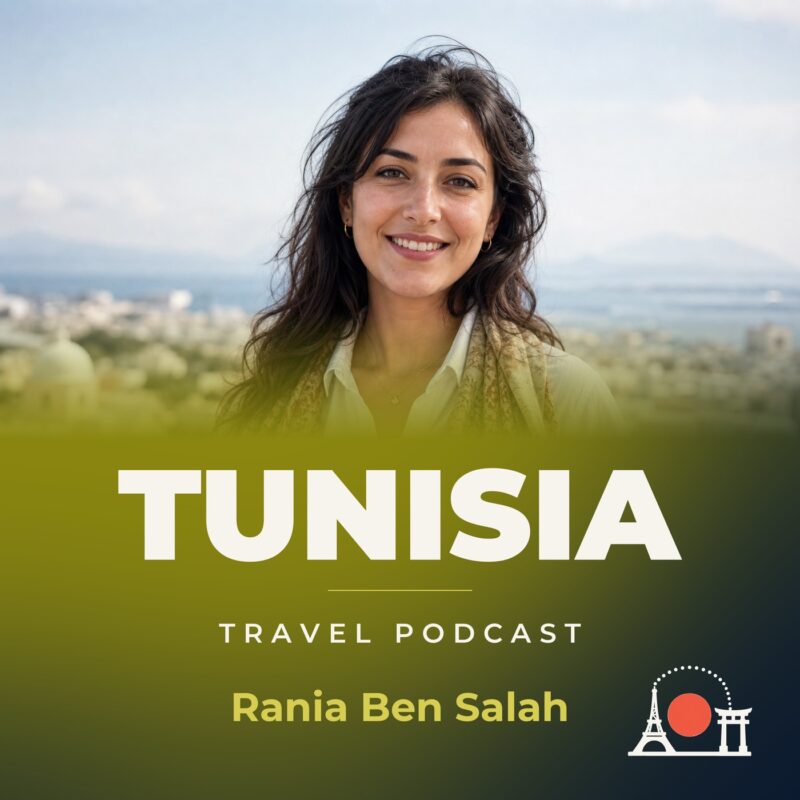
Tunisia Travel Podcast with Rania Ben Salah
Hosted by Rania Ben Salah — a new episode every day from Tunisia.
Tunisia Travel Podcast with Rania Ben Salah is a series about moving through the country slowly, with attention to how the Mediterranean location, long imperial history, and shifting terrain shape daily life. The landscape runs from the northern mountains to the hot central plain and the semiarid south merging into the Sahara, so journeys become changes in climate as much as distance.
She starts in Tunis, the capital, then travels to Ain Draham in the northern mountains, crosses the central plain around Kairouan, and reaches the oasis town of Tozeur on the edge of the Sahara. Each place changes the texture of the show: city streets, forest trails, olive plains, desert palm groves.
Over a couple of years, the show settles in a place, returns to it through different seasons, and eventually moves on to somewhere connected. The northern mountains become familiar through winter rain and summer dryness, the central plain through its heat, and the Sahara through wind and shifting dust.
Recent episodes
Things to do in Tunisia
 VIP transfer between Tunis Carthage Airport and a hotel in Tunis
 07 -Guided day Tour Tunisia Monumental
 2D/1N Private Adventure – Explore Southern Tunisia, Douz & Tozeur
 Horseback riding with private transfer
 Dromedary Expedition with Night in Camp and Sandboard
 Excursion VIP Tunis Medina, Bardo Carthage & Sidi BouSaid
 10 Day Historical and Cultural Tour of Tunisia
 8 Days Tunisia Essential Discovery Private Tour
Plan your trip to Tunisia
Getting around
Staying connected
Tunisia at a glance
Tunisia in depth
Reference data on the country — geography, people, history, economy and transport.
Geography and climate
Location
Northern Africa, bordering the Mediterranean Sea, between Algeria and Libya
Terrain
Mountains in north; hot, dry central plain; semiarid south merges into the Sahara
Climate
Temperate in north with mild, rainy winters and hot, dry summers; desert in south
Elevation
- Highest point
- Jebel ech Chambi 1,544 m
- Lowest point
- Shatt al Gharsah -17 m
- Mean elevation
- 246 m
Area
- Total
- 163,610 sq km
- Land
- 155,360 sq km
- Water
- 8,250 sq km
Size comparison
Slightly larger than Georgia
Coastline
1,148 km
Land borders
- Total
- 1,495 km
- Border countries
- Algeria 1,034 km; Libya 461 km
Natural resources
Petroleum, phosphates, iron ore, lead, zinc, salt
Land use
- Agricultural land
- 62.4% (2023 est.)
- Arable land
- 18.2% (2023 est.)
- Permanent crops
- 13.6% (2023 est.)
- Permanent pasture
- 30.6% (2023 est.)
- Forest
- 4.5% (2023 est.)
- Other
- 33.1% (2023 est.)
Natural hazards
Flooding; earthquakes; droughts
Note
Strategic location in central Mediterranean
People and society
Population
- Total
- 11,962,995 (2025 est.)
- Male
- 5,926,741
- Female
- 6,036,254
Nationality
- Noun
- Tunisian(s)
- Adjective
- Tunisian
Ethnic groups
Arab 98%, European 1%, Jewish and other 1%
Languages
- Languages
- Arabic (official, one of the languages of commerce), French (commerce), Tamazight
- Major-language sample(s)
- كتاب حقائق العالم، أحسن كتاب تتعلم به المعلومات الأساسية (Arabic)
Religions
Muslim (official; Sunni) 99%, other (includes Christian, Jewish, Shia Muslim, and Baha'i) <1%
Median age
- Total
- 34.1 years (2025 est.)
- Male
- 33.6 years
- Female
- 35.1 years
Life expectancy
- Total population
- 77.3 years (2024 est.)
- Male
- 75.7 years
- Female
- 79.1 years
Urbanisation
- Urban population
- 70.5% of total population (2023)
- Rate of urbanization
- 1.34% annual rate of change (2020-25 est.)
Where people live
The overwhelming majority of the population is located in the northern half of the country; the south remains largely underpopulated, as shown in this population distribution map
Largest cities
2.475 million TUNIS (capital) (2023)
Background and government
Background
Many empires have controlled Tunisia, including the Phoenicians (as early as the 12 century B.C.), Carthaginians, Romans, Vandals, Byzantines, various Arab and Berber kingdoms, and Ottomans (16th to late-19th centuries). Rivalry between French and Italian interests in Tunisia culminated in a French invasion in 1881 and the creation of a protectorate. Agitation for independence in the decades after World War I finally convinced the French to recognize Tunisia as an independent state in 1956. The country's first president, Habib BOURGUIBA, established a strict one-party state. He dominated the country for 31 years, repressing Islamic fundamentalism and establishing rights for women. In 1987, Zine el Abidine BEN ALI replaced BOURGUIBA in a bloodless coup.
Street protests that began in Tunis in 2010 over high unemployment, corruption, widespread poverty, and high food prices escalated in 2011, culminating in rioting that led to hundreds of deaths and later became known as the start of the regional Arab Spring uprising. BEN ALI dismissed the government and fled the country, and a "national unity government" was formed. Elections for the new Constituent Assembly were held later that year, and human rights activist Moncef MARZOUKI was elected as interim president. The Assembly began drafting a new constitution in 2012 and, after several iterations and a months-long political crisis that stalled the transition, ratified the document in 2014. Parliamentary and presidential elections for a permanent government were held at the end of 2014. Beji CAID ESSEBSI was elected as the first president under the country's new constitution. After ESSEBSI’s death in office in 2019, Kais SAIED was elected. SAIED's term, as well as that of Tunisia's 217-member parliament, was set to expire in 2024. However, in 2021, SAIED used the exceptional powers allowed under Tunisia's constitution to dismiss the prime minister and suspend the legislature. Tunisians approved a new constitution through public referendum in 2022, expanding presidential powers and creating a new bicameral legislature.
Government
Parliamentary republic
Capital
Tunis
Time zone
UTC+1 (6 hours ahead of Washington, DC, during Standard Time)
Local name
Al Jumhuriyah at Tunisiyah
Independence
20 March 1956 (from France)
National day
Independence Day, 20 March (1956); Revolution and Youth Day, 14 January (2011)
Economy and cost of living
Overview
Lower middle-income North African economy; drafting reforms for foreign lenders; high unemployment, especially for youth and women; hit hard by COVID-19; high public sector wages; high public debt; protectionist austerity measures; key EU trade partner
GDP per capita
- Real GDP per capita 2024
- $12,700 (2024 est.)
- Real GDP per capita 2023
- $12,600 (2023 est.)
- Real GDP per capita 2022
- $12,700 (2022 est.)
Inflation
- Inflation rate (consumer prices) 2024
- 7.2% (2024 est.)
- Inflation rate (consumer prices) 2023
- 9.3% (2023 est.)
- Inflation rate (consumer prices) 2022
- 8.3% (2022 est.)
Unemployment
- Unemployment rate 2024
- 16.3% (2024 est.)
- Unemployment rate 2023
- 15.2% (2023 est.)
- Unemployment rate 2022
- 15.3% (2022 est.)
Exchange rate
- Currency
- Tunisian dinars (TND) per US dollar -
- Exchange rates 2024
- 3.107 (2024 est.)
- Exchange rates 2023
- 3.106 (2023 est.)
- Exchange rates 2022
- 3.104 (2022 est.)
- Exchange rates 2021
- 2.794 (2021 est.)
- Exchange rates 2020
- 2.812 (2020 est.)
Main industries
Petroleum, mining (particularly phosphate, iron ore), tourism, textiles, footwear, agribusiness, beverages
Agriculture
Milk, tomatoes, olives, onions, chillies/peppers, watermelons, potatoes, wheat, dates, oranges (2023)
Transport and connectivity
Airports
14 (2025)
Railways
- Total
- 2,173 km (2014) (1,991 in use)
- Standard gauge
- 471 km (2014) 1.435-m gauge
- Narrow gauge
- 1,694 km (2014) 1.000-m gauge (65 km electrified)
- Dual gauge
- 8 km (2014) 1.435-1.000-m gauge
Ports
- Total ports
- 16 (2024)
- Large
- 0
- Medium
- 3
- Small
- 7
- Very small
- 6
- Ports with oil terminals
- 10
- Key ports
- Ashtart Oil Terminal, Banzart, Didon Terminal, Gabes, La Goulette, Menzel Bourguiba, Mersa Sfax, Sousse, Tazerka Oil Terminal, Tunis
Internet domain
.tn
Internet users
Percent of population 72% (2023 est.)
Mobile subscriptions
- Total subscriptions
- 14.4 million (2024 est.)
- Subscriptions per 100 inhabitants
- 118 (2024 est.)
Environment
Environmental issues
Toxic and hazardous waste disposal; water pollution from raw sewage; limited freshwater resources; deforestation; overgrazing; soil erosion; desertification
Fresh water
4.615 billion cubic meters (2022 est.)
Country reference figures are periodically revised. Check anything time-sensitive or safety-critical against an official source before you travel.
Tunisia travel guides
 Getting Around
From the airport into Tunis: every option and what it costs
Navigate Tunis-Carthage Airport with ease. Real costs, times, and tips for taxis, trams, trains, and transfers to the city center and Sidi Bou Said.
 News & Updates
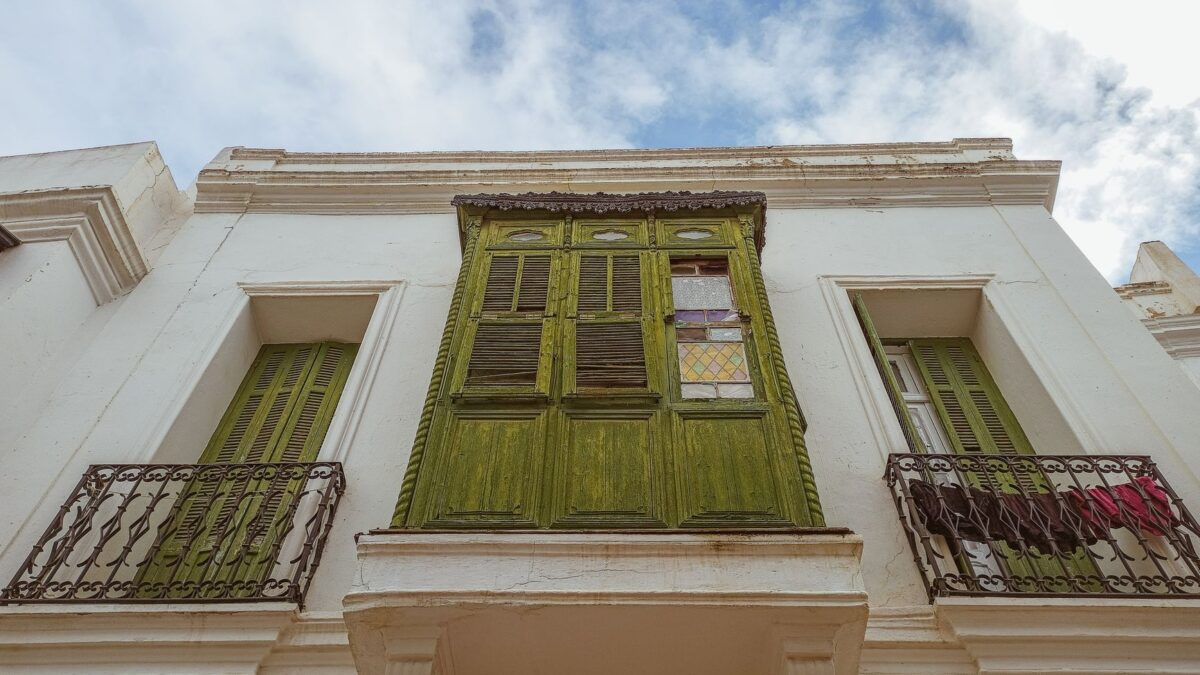
Tunisia in September 2026: what travelers should know now
Tunisia travel update Sept 2026: Weather, Carthage Off concerts, ASBU festival, costs & practical tips for visitors arriving now.
 News & Updates
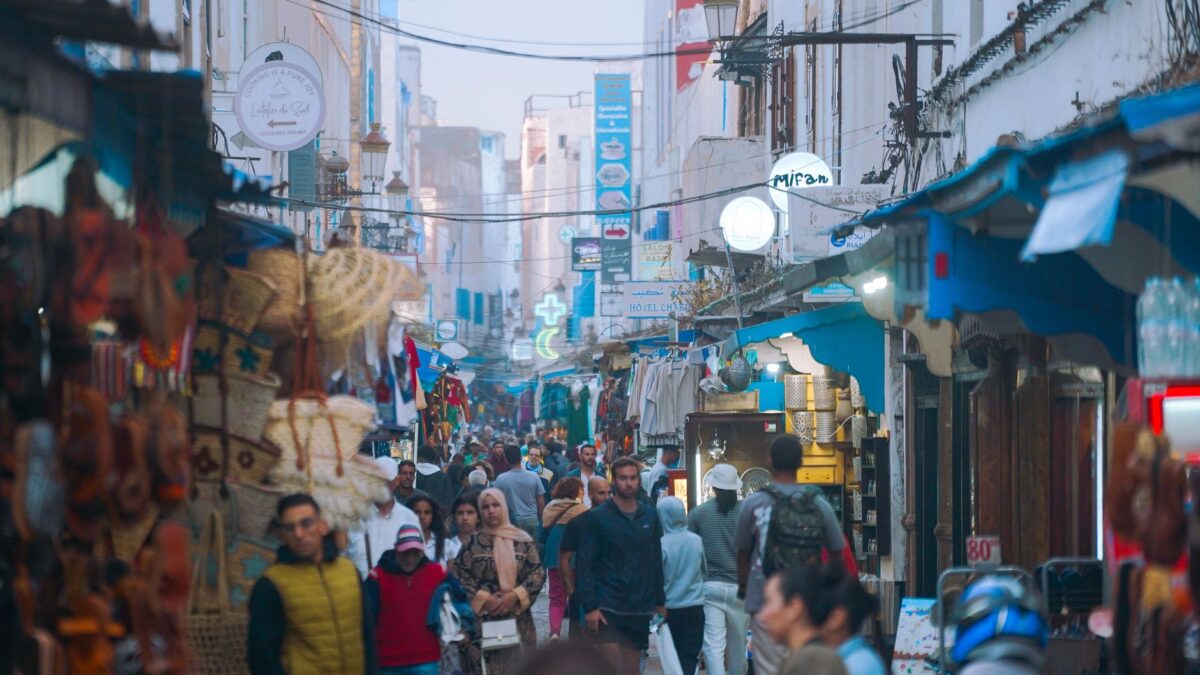
Tunisia in August 2026: what travelers should know now
Tunisia in August 2026: weather, festivals, street food prices, practical tips for Tunis. What to know this month from a local host.
 Living Abroad
Moving to Tunisia: visas, banking and SIM cards
Moving to Tunisia? Get the practical first-week guide: visas, carte de séjour, opening a bank account, getting a SIM card, and settling into Tunis.
North Africa
 Egypt
EgyptEgypt Travel Podcast with Nour Hassan
The Nile's annual flood, along with the deserts to the east and west, allowed one of the world's great civilizations to develop…
 Morocco
Morocco Travel Podcast with Youssef Benali
The Atlantic coast brings cold offshore fog and heavy dew, while the Rif Mountains and the Sahara desert lie within a single…