


Ghana Travel Podcast with Ama Boateng
Hosted by Ama Boateng — a new episode every day from Ghana.
Each series follows one resident’s way of living in Ghana, moving from a new base to the places connected to it. Travel here means reading the terrain: low plains, the dissected plateau in the south-central area, and a coast that is warmer and drier than the humid southwest.
The host covers Accra’s coastal density, Kumasi’s Asante markets, Sekondi Takoradi’s twin-port Atlantic edge, and the Bono region, where the gold trade once shaped Akan power. Each place shows a different Ghana: the capital, the inland commercial city, the western coastline, and a historical interior.
The show unfolds by returning. She settles in one place, learns it, then moves somewhere connected to it, and later comes back after the dry season has shifted into rain. The slow accumulation of that routine is the point: knowing one corner of Ghana properly before following its links.
Recent episodes
Things to do in Ghana
 Ghana Heritage Tours - Beyond The Return
 African Drum and Dance Lessons
 Special offer
Cape Coast and Elmina Slave Castles Day Tour
Special offer
Cape Coast and Elmina Slave Castles Day Tour
 Cape Coast Castle, Assin Manso Slave River & Kakum Day Tour.
 Makola Market Walking Tour
 Full-Day Private Culture and History Tour of Accra
 Experience Authentic Ghana in a Personalized Accra City Tour
 Cape Coast/Elmina Slave Dungeon and Canopy Walkway Private Tour
Plan your trip to Ghana
Getting around
Staying connected
Ghana at a glance
Ghana in depth
Reference data on the country — geography, people, history, economy and transport.
Geography and climate
Location
Western Africa, bordering the Gulf of Guinea, between Cote d'Ivoire and Togo
Terrain
Mostly low plains with dissected plateau in south-central area
Climate
Tropical; warm and comparatively dry along southeast coast; hot and humid in southwest; hot and dry in north
Elevation
- Highest point
- Mount Afadjato 885 m
- Lowest point
- Atlantic Ocean 0 m
- Mean elevation
- 190 m
Area
- Total
- 238,533 sq km
- Land
- 227,533 sq km
- Water
- 11,000 sq km
Size comparison
Slightly smaller than Oregon
Coastline
539 km
Land borders
- Total
- 2,420 km
- Border countries
- Burkina Faso 602 km; Cote d'Ivoire 720 km; Togo 1098 km
Natural resources
Gold, timber, industrial diamonds, bauxite, manganese, fish, rubber, hydropower, petroleum, silver, salt, limestone
Land use
- Agricultural land
- 55.4% (2023 est.)
- Arable land
- 20.7% (2023 est.)
- Permanent crops
- 11.9% (2023 est.)
- Permanent pasture
- 22.8% (2023 est.)
- Forest
- 30.7% (2023 est.)
- Other
- 13.9% (2023 est.)
Natural hazards
Dry, dusty, northeastern harmattan winds from January to March; droughts
Note
Lake Volta is the world's largest artificial lake (manmade reservoir) by surface area (8,482 sq km; 3,275 sq mi); the lake was created after the Akosombo Dam was completed in 1965
People and society
Population
- Total
- 35,336,133 (2025 est.)
- Male
- 17,278,776
- Female
- 18,057,357
Nationality
- Noun
- Ghanaian(s)
- Adjective
- Ghanaian
Ethnic groups
Akan 45.7%, Mole-Dagbani 18.5%, Ewe 12.8%, Ga-Dangme 7.1%, Gurma 6.4%, Guan 3.2%, Grusi 2.7%, Mande 2%, other 1.6% (2021 est.)
Languages
Asante 16%, Ewe 14%, Fante 11.6%, Boron (Brong) 4.9%, Dagomba 4.4%, Dangme 4.2%, Dagarte (Dagaba) 3.9%, Kokomba 3.5%, Akyem 3.2%, Ga 3.1%, other 31.2% (2010 est.)
Religions
Christian 71.3% (Pentecostal/Charismatic 31.6%, Protestant 17.4%, Catholic 10%, other 12.3%), Muslim 19.9%, traditionalist 3.2%, other 4.5%, none 1.1% (2021 est.)
Median age
- Total
- 21.6 years (2025 est.)
- Male
- 20.6 years
- Female
- 22.3 years
Life expectancy
- Total population
- 70.1 years (2024 est.)
- Male
- 68.4 years
- Female
- 71.8 years
Urbanisation
- Urban population
- 59.2% of total population (2023)
- Rate of urbanization
- 3.06% annual rate of change (2020-25 est.)
Where people live
Population is concentrated in the southern half of the country, with the highest concentrations on or near the Atlantic coast, as shown in this population distribution map
Largest cities
3.768 million Kumasi, 2.660 million ACCRA (capital), 1.078 million Sekondi Takoradi (2023)
Background and government
Background
Ghana is a multiethnic country rich in natural resources and is one of the most stable and democratic countries in West Africa. Ghana has been inhabited for at least several thousand years, but little is known about its early inhabitants. By the 12th century, the gold trade started to boom in Bono (Bonoman) state in what is today southern Ghana, and it became the genesis of the Akan people's power and wealth in the region. Beginning in the 15th century, the Portuguese, followed by other European powers, arrived and competed for trading rights. Numerous kingdoms and empires emerged in the area, among the most powerful were the Kingdom of Dagbon in the north and the Asante (Ashanti) Empire in the south. By the mid-18th century, Asante was a highly organized state with immense wealth; it provided enslaved people for the Atlantic slave trade, and in return received firearms that facilitated its territorial expansion. The Asante resisted increasing British influence in the coastal areas, engaging in a series of wars during the 19th century before ultimately falling under British control. Formed from the merger of the British colony of the Gold Coast and the Togoland trust territory, Ghana in 1957 became the first Sub-Saharan country in colonial Africa to gain its independence, with Kwame NKRUMAH as its first leader.
Ghana endured a series of coups before Lt. Jerry RAWLINGS took power in 1981 and banned political parties. After approving a new constitution and restoring multiparty politics in 1992, RAWLINGS won presidential elections in 1992 and 1996 but was constitutionally prevented from running for a third term in 2000. John KUFUOR of the opposition New Patriotic Party (NPP) succeeded him and was reelected in 2004. John Atta MILLS of the National Democratic Congress won the 2008 presidential election and took over as head of state. MILLS died in 2012 and was constitutionally succeeded by his vice president, John Dramani MAHAMA, who subsequently won the 2012 presidential election. In 2016, Nana Addo Dankwa AKUFO-ADDO of the NPP defeated MAHAMA, marking the third time that Ghana’s presidency had changed parties since the return to democracy. AKUFO-ADDO was reelected in 2020. In recent years, Ghana has taken an active role in promoting regional stability and is highly integrated in international affairs.
Government
Presidential republic
Capital
Accra
Time zone
UTC 0 (5 hours ahead of Washington, DC, during Standard Time)
Independence
6 March 1957 (from the UK)
National day
Independence Day, 6 March (1957)
Economy and cost of living
Overview
West African lower-middle income economy; major gold, oil and cocoa exporter; macroeconomic challenges following nearly four decades of sustained growth; recent progress in debt restructuring, fiscal reforms, financial stability, and curbing runaway inflation under 2023-26 IMF credit facility program
GDP per capita
- Real GDP per capita 2024
- $7,100 (2024 est.)
- Real GDP per capita 2023
- $6,800 (2023 est.)
- Real GDP per capita 2022
- $6,700 (2022 est.)
Inflation
- Inflation rate (consumer prices) 2024
- 22.8% (2024 est.)
- Inflation rate (consumer prices) 2023
- 38.1% (2023 est.)
- Inflation rate (consumer prices) 2022
- 31.3% (2022 est.)
Unemployment
- Unemployment rate 2024
- 3.1% (2024 est.)
- Unemployment rate 2023
- 3.1% (2023 est.)
- Unemployment rate 2022
- 3.1% (2022 est.)
Exchange rate
- Currency
- Cedis (GHC) per US dollar -
- Exchange rates 2023
- 11.02 (2023 est.)
- Exchange rates 2022
- 8.272 (2022 est.)
- Exchange rates 2021
- 5.806 (2021 est.)
- Exchange rates 2020
- 5.596 (2020 est.)
- Exchange rates 2019
- 5.217 (2019 est.)
Main industries
Mining, lumbering, light manufacturing, aluminum smelting, food processing, cement, small commercial ship building, petroleum
Agriculture
Cassava, yams, plantains, maize, oil palm fruit, taro, rice, oranges, pineapples, cocoa beans (2023)
Transport and connectivity
Airports
11 (2025)
Railways
- Total
- 947 km (2022)
- Narrow gauge
- 947 km (2022) 1.067-m gauge
Ports
- Total ports
- 4 (2024)
- Large
- 0
- Medium
- 1
- Small
- 1
- Very small
- 2
- Ports with oil terminals
- 3
- Key ports
- Saltpond, Sekondi, Takoradi, Tema
Internet domain
.gh
Internet users
Percent of population 70% (2023 est.)
Mobile subscriptions
- Total subscriptions
- 39.1 million (2024 est.)
- Subscriptions per 100 inhabitants
- 114 (2024 est.)
Environment
Environmental issues
Drought in north; deforestation; overgrazing; soil erosion; poaching and habitat destruction; water pollution; inadequate potable water
Fresh water
56.2 billion cubic meters (2022 est.)
Country reference figures are periodically revised. Check anything time-sensitive or safety-critical against an official source before you travel.
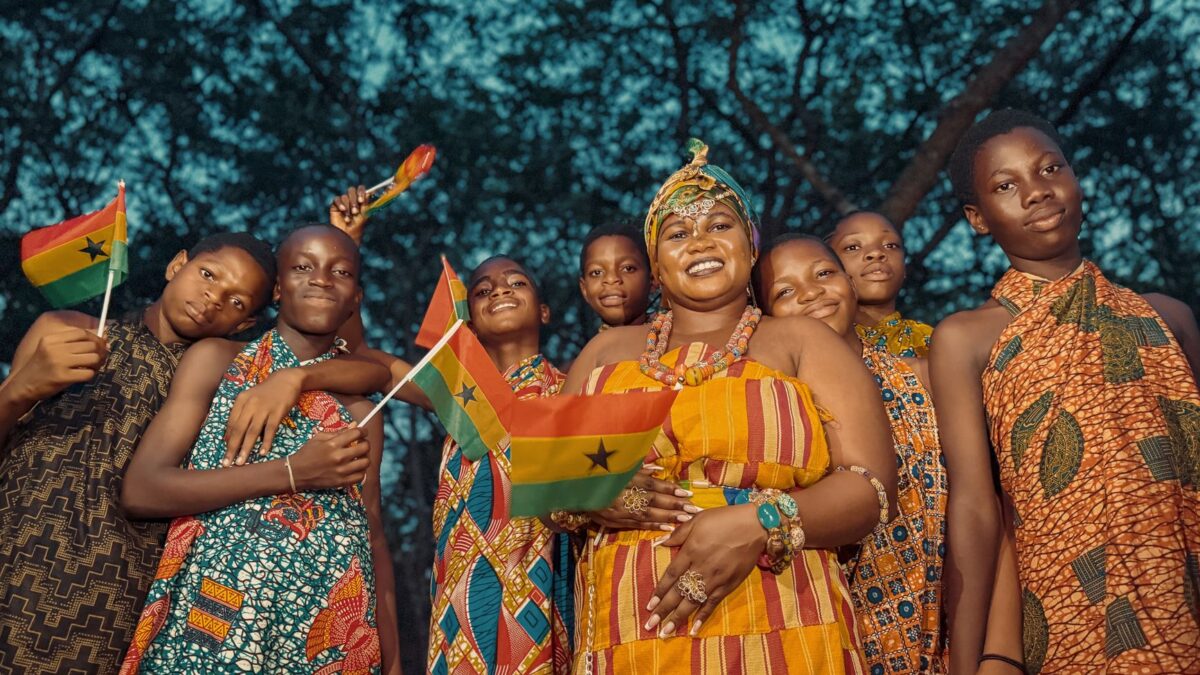
West Africa
 Nigeria
Nigeria Travel Podcast with Chidi Okafor
The Niger River enters from the northwest, crosses the country's southern rainforests and swamps, then reaches its delta in the Gulf of…
 Senegal
Senegal Travel Podcast with Fatou Diop
The harmattan dusts Dakar's streets from December to April, while the rainy season's strong southeast winds bring rain to the interior plains…