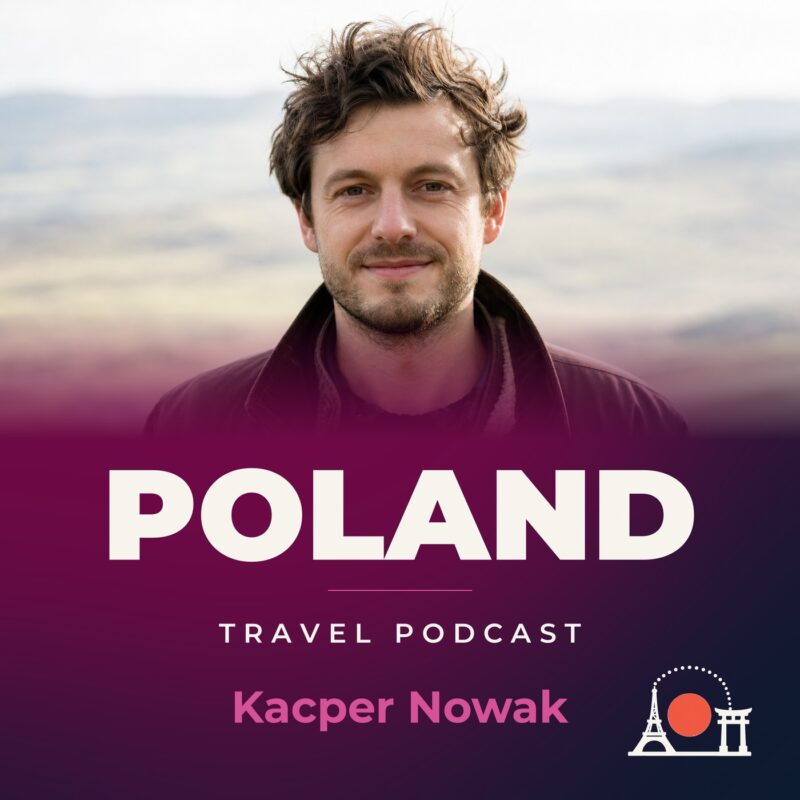
Poland Travel Podcast with Kacper Nowak
Hosted by Kacper Nowak — a new episode every day from Poland.
The Poland Travel Podcast follows a single host as he settles in one Polish city or region, learns its everyday rhythms, then moves somewhere connected to it. Poland’s distinctiveness lies in its geography: a flat plain that invites movement, mountains along the southern border, and weather that ranges from snowy winters to thundery summers. Travelling here means paying attention to layers of history.
The range covers Kraków and the medieval streets of the south, Warsaw’s reconstructed centre, the industrial city of Łódź, and the lake district in the north-east. It also reaches Silesia with its coal-mining towns and the Białowieża Forest on the eastern border. These places are seldom treated as a checklist; each gets episodes that return to the same streets in different light.
The show unfolds across a Polish year, so episodes move with the seasons: winter fog in Łódź, thaw in the Tatra foothills, summer storms on the plains. The host returns to places he has already visited, notices what has changed, and builds a picture of Poland from the accumulation of ordinary details. That is how the podcast works.
Recent episodes
Things to do in Poland
 Private Bike Tour in Krakow
 Krakow: Guided Sightseeing Tour by golf cart/buggy
 Warsaw City Sightseeing in a Retro Bus for Groups
 Majdanek Concentration Camp & Lublin Full Day Private Tour from Warsaw
 Guided Winter Kayak Tour in Gdańsk & Hot Chocolate Treat
 Zakopane Snowmobile and Thermal Baths Full Day Tour from Krakow
 Warsaw Photographer - One Hour 200 Photos
 E-Scooter Rental in Krakow for 4 hours
Plan your trip to Poland
Getting around
Staying connected
Poland at a glance
Poland in depth
Reference data on the country — geography, people, history, economy and transport.
Geography and climate
Location
Central Europe, east of Germany
Terrain
Mostly flat plain; mountains along southern border
Climate
Temperate with cold, cloudy, moderately severe winters with frequent precipitation; mild summers with frequent showers and thundershowers
Elevation
- Highest point
- Rysy 2,499 m
- Lowest point
- Near Raczki Elblaskie -2 m
- Mean elevation
- 173 m
Area
- Total
- 312,685 sq km
- Land
- 304,255 sq km
- Water
- 8,430 sq km
Size comparison
About twice the size of Georgia; slightly smaller than New Mexico
Coastline
440 km
Land borders
- Total
- 2,865 km
- Border countries
- Belarus 375 km; Czechia 699 km; Germany 467 km; Lithuania 100 km, Russia (Kaliningrad Oblast) 209 km; Slovakia 517 km; Ukraine 498 km
Natural resources
Coal, sulfur, copper, natural gas, silver, lead, salt, amber, arable land
Land use
- Agricultural land
- 47.6% (2023 est.)
- Arable land
- 36.6% (2023 est.)
- Permanent crops
- 1.1% (2023 est.)
- Permanent pasture
- 9.8% (2023 est.)
- Forest
- 31% (2023 est.)
- Other
- 21% (2023 est.)
Natural hazards
Flooding
Note
Historically an area of conflict because of flat terrain and the lack of natural barriers on the North European Plain
People and society
Population
- Total
- 38,746,310 (2024 est.)
- Male
- 18,441,415
- Female
- 20,304,895
Nationality
- Noun
- Pole(s)
- Adjective
- Polish
Ethnic groups
Polish 96.9%, Silesian 1.1%, German 0.2%, Ukrainian 0.1%, other and unspecified 1.7% (2011 est.)
Languages
- Languages
- Polish (official) 98.2%, Silesian 1.4%, other 1.1%, unspecified 1.2% (2011 est.)
- Major-language sample(s)
- Księga Faktów Świata, niezbędne źródło podstawowych informacji. (Polish)
Religions
Roman Catholic 70.7%, refused to answer 20.9%, no religion 6.9%; less than 1 percent: Orthodox, Jehovah Witness, Evangelic of Augsburg, Greek Catholic, Pentecostal, other Protestant, not stated, old Catholic Mariavite Church, other Christians, Islam, Buddhist, Polish Catholic Church, other, Baptist Union of Poland, Pagan, Seventh Day Adventist, Hindu, other Catholic (2021 est.)
Median age
- Total
- 43.4 years (2025 est.)
- Male
- 41.5 years
- Female
- 44.3 years
Life expectancy
- Total population
- 76.7 years (2024 est.)
- Male
- 72.8 years
- Female
- 80.9 years
Urbanisation
- Urban population
- 60.2% of total population (2023)
- Rate of urbanization
- -0.16% annual rate of change (2020-25 est.)
Where people live
Population concentrated in the southern area around Krakow and the central area around Warsaw and Lodz, with an extension to the northern coastal city of Gdansk
Largest cities
1.798 million WARSAW (capital), 769,000 Krakow (2023)
Background and government
Background
Poland's history as a state began near the middle of the 10th century. By the mid-16th century, the Polish-Lithuanian Commonwealth ruled a vast tract of land in Central and Eastern Europe. During the 18th century, internal disorder weakened the nation, and in a series of agreements between 1772 and 1795, Russia, Prussia, and Austria partitioned Poland among themselves. Poland regained its independence in 1918 only to be overrun by Germany and the Soviet Union in World War II. It became a Soviet satellite state following the war. Labor turmoil in 1980 led to the formation of the independent trade union Solidarity that over time became a political force with over 10 million members. Free elections in 1989 and 1990 won Solidarity control of the parliament and the presidency, bringing the communist era to a close. A "shock therapy" program during the early 1990s enabled the country to transform its economy into one of the most robust in Central Europe. Poland joined NATO in 1999 and the EU in 2004.
Government
Parliamentary republic
Capital
Warsaw
Time zone
UTC+1 (6 hours ahead of Washington, DC, during Standard Time)
Local name
Rzeczpospolita Polska
Independence
11 November 1918 (republic proclaimed); notable earlier dates: 14 April 966 (adoption of Christianity, traditional founding date), 1 July 1569 (Polish-Lithuanian Commonwealth created)
National day
Constitution Day, 3 May (1791)
Economy and cost of living
Overview
High-income, diversified, EU-member economy; significant growth in GDP, trade, and investment since joining EU in 2004; private consumption and EU-funded public investments driving GDP growth; increased social spending, flooding recovery costs, and defense spending have added to public debt
GDP per capita
- Real GDP per capita 2024
- $45,100 (2024 est.)
- Real GDP per capita 2023
- $43,700 (2023 est.)
- Real GDP per capita 2022
- $43,400 (2022 est.)
Inflation
- Inflation rate (consumer prices) 2024
- 3.8% (2024 est.)
- Inflation rate (consumer prices) 2023
- 11.5% (2023 est.)
- Inflation rate (consumer prices) 2022
- 14.4% (2022 est.)
Unemployment
- Unemployment rate 2024
- 2.5% (2024 est.)
- Unemployment rate 2023
- 2.8% (2023 est.)
- Unemployment rate 2022
- 2.9% (2022 est.)
Exchange rate
- Currency
- Zlotych (PLN) per US dollar -
- Exchange rates 2024
- 3.981 (2024 est.)
- Exchange rates 2023
- 4.204 (2023 est.)
- Exchange rates 2022
- 4.458 (2022 est.)
- Exchange rates 2021
- 3.862 (2021 est.)
- Exchange rates 2020
- 3.9 (2020 est.)
Main industries
Machine building, iron and steel, coal mining, chemicals, shipbuilding, food processing, glass, beverages, textiles
Agriculture
Sugar beets, milk, wheat, maize, potatoes, triticale, apples, rapeseed, barley, rye (2023)
Transport and connectivity
Airports
318 (2025)
Railways
Total 19,461 km (2020) 11,946 km electrified
Ports
- Total ports
- 10 (2024)
- Large
- 2
- Medium
- 2
- Small
- 4
- Very small
- 2
- Ports with oil terminals
- 5
- Key ports
- Gdansk, Gdynia, Port Polnochny, Szczecin
Internet domain
.pl
Internet users
Percent of population 86% (2023 est.)
Mobile subscriptions
- Total subscriptions
- 52.4 million (2023 est.)
- Subscriptions per 100 inhabitants
- 132 (2022 est.)
Environment
Environmental issues
Air pollution (despite environmental policy improvements) because of coal-burning in homes and power plants; acid rain leading to forest damage; water pollution from industrial and municipal sources; disposal of hazardous wastes
Fresh water
60.5 billion cubic meters (2022 est.)
UNESCO Global Geoparks
- Total global geoparks and regional networks
- 3 (2024)
- Global geoparks and regional networks
- Land of Extinct Volcanoes; Muskauer Faltenbogen / Łuk Mużakowa (includes Germany); Holy Cross Mountains (2024)
Country reference figures are periodically revised. Check anything time-sensitive or safety-critical against an official source before you travel.
Poland travel guides
 Living Abroad
Moving to Poland: visas, banking and SIM cards
Moving to Poland? Your essential guide to visas, banking, SIM cards, and registering your address in Warsaw for a smooth start.
 News & Updates
Poland in September 2026: what travelers should know now
Poland travel briefing for September 2026: weather, tram updates, festivals, and costs in Warsaw.
 Food & Drink
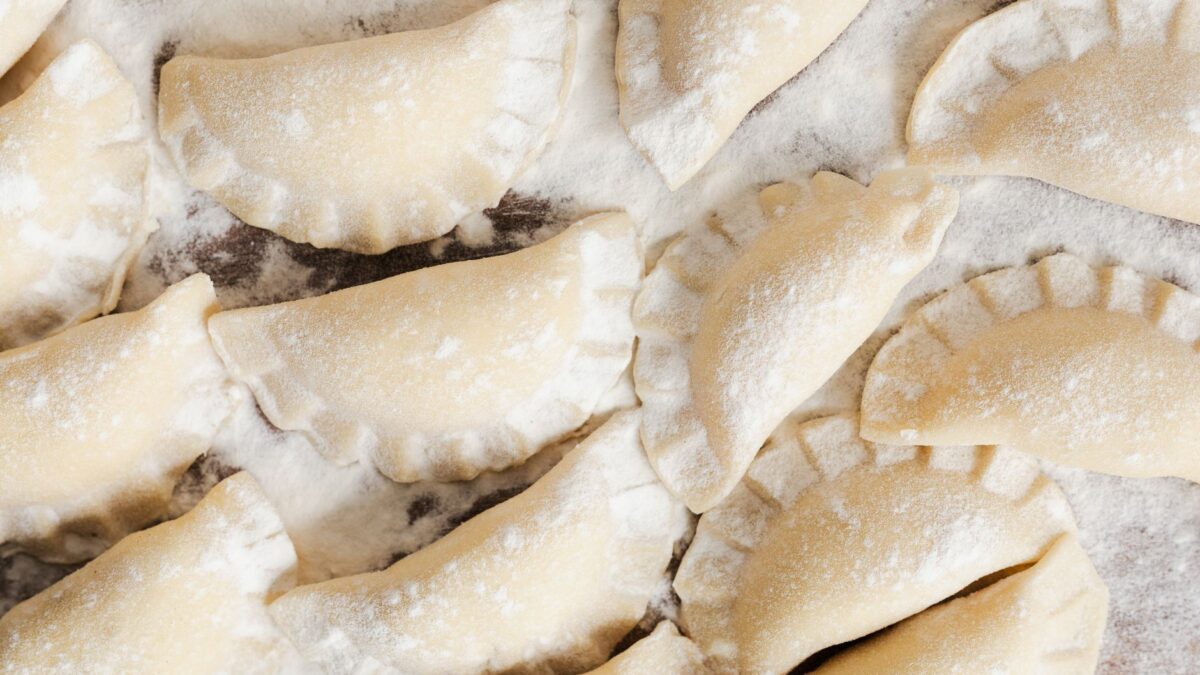
What to eat in Poland — and what it costs
Discover the best Polish food in Warsaw, from milk bars to fine dining. Real prices, top venues, and local tips for an authentic culinary…
 Travel Tips
A first-timer’s guide to Poland
Your practical guide to Poland: best times to visit, costs in PLN, navigating Warsaw's trams, and hidden gems from a local perspective.
Eastern Europe
 Czechia
Czechia Travel Podcast with Tereza Nováková
From Prague to the Moravian Gate, this show follows one resident learning Czechia's landscapes over seasons, with low mountains and hilly country…
 Hungary
Hungary Travel Podcast with Bence Kovács
Budapest, the capital and largest city, stands on the Duna, one of the two rivers that split Hungary into three regions.
 Romania
Romania Travel Podcast with Ioana Popescu
The Eastern Carpathians separate the Transylvanian Basin from the Moldavian Plateau, shaping a central Romania of foggy winters and summer storms.
 Bulgaria
Bulgaria Travel Podcast with Georgi Dimitrov
The Balkan Mountains run east-west across Bulgaria, separating the Danubian plain from the Thracian lowlands, and shaping the country's cold winters and…