

Romania Travel Podcast with Ioana Popescu
Hosted by Ioana Popescu — a new episode every day from Romania.
This podcast follows one resident’s route through Romania, settling in a place long enough to learn it before moving on to somewhere connected to it. Romanian travel is shaped by the Carpathians running through the centre, the Danube forming much of the southern boundary with Serbia and Bulgaria, and a fairly even population spread across the country.
The host covers Bucharest’s dense urban districts, the Eastern Carpathians’ forested ridges, Maramureș’s wooden churches and haystacks, and the Danube Delta’s channels. These are not separate attractions; they are connected by history, including the union of Wallachia and Moldavia and the later acquisition of Transylvania.
The show unfolds across seasons in a temperate climate: cold, cloudy winters with frequent snow and fog, and sunny summers with frequent showers and thunderstorms. She returns to places already visited, watching how they change and how her own understanding deepens with each return. This slow accumulation of knowledge is the point of the podcast.
Recent episodes
Things to do in Romania
 Bucovina Painted Monasteries Day Tour
 Timisoara All in One - Walking and Tram Tour
 Half-Day Private Food and Wine Walking Tour Oradea Romania
 Private Day Trip from Bucharest: Dracula’s Castle, Peles & Brasov
 Private Walking Tour: Essential Bucharest + Hidden Gems
 Bran (Dracula) Castle, Bear Sanctuary, Rasnov Fortress & Palinca Distillery
 Bucharest Old Town Party Night Out - Perfect for Hen/Stag Groups
 Special offer
Contrasts of Communism - Small Group Walking Tour in Bucharest
Special offer
Contrasts of Communism - Small Group Walking Tour in Bucharest
Plan your trip to Romania
Getting around
Staying connected
Romania at a glance
Romania in depth
Reference data on the country — geography, people, history, economy and transport.
Geography and climate
Location
Southeastern Europe, bordering the Black Sea, between Bulgaria and Ukraine
Terrain
Central Transylvanian Basin is separated from the Moldavian Plateau on the east by the Eastern Carpathian Mountains and separated from the Walachian Plain on the south by the Transylvanian Alps
Climate
Temperate; cold, cloudy winters with frequent snow and fog; sunny summers with frequent showers and thunderstorms
Elevation
- Highest point
- Moldoveanu 2,544 m
- Lowest point
- Black Sea 0 m
- Mean elevation
- 414 m
Area
- Total
- 238,391 sq km
- Land
- 229,891 sq km
- Water
- 8,500 sq km
Size comparison
Twice the size of Pennsylvania; slightly smaller than Oregon
Coastline
225 km
Land borders
- Total
- 2,844 km
- Border countries
- Bulgaria 605 km; Hungary 424 km; Moldova 683 km; Serbia 531 km; Ukraine 601 km
Natural resources
Petroleum (reserves declining), timber, natural gas, coal, iron ore, salt, arable land, hydropower
Land use
- Agricultural land
- 55.3% (2023 est.)
- Arable land
- 36.5% (2023 est.)
- Permanent crops
- 1.8% (2023 est.)
- Permanent pasture
- 17% (2023 est.)
- Forest
- 30.2% (2023 est.)
- Other
- 14.5% (2023 est.)
Natural hazards
Earthquakes, most severe in south and southwest; geologic structure and climate promote landslides
Note
Controls the most easily traversable land route between the Balkans, Moldova, and Ukraine; the Carpathian Mountains dominate the center of the country, and the Danube River forms much of the southern boundary with Serbia and Bulgaria
People and society
Population
- Total
- 18,148,155 (2024 est.)
- Male
- 8,747,795
- Female
- 9,400,360
Nationality
- Noun
- Romanian(s)
- Adjective
- Romanian
Ethnic groups
Romanian 89.3%, Hungarian 6%, Romani 3.4%, Ukrainian 0.3%, German 0.1%, other 0.9% (2021 est.)
Languages
- Languages
- Romanian (official) 91.6%, Hungarian 6.3%, Romani 1.2%, other 0.7% (2021 est.)
- Major-language sample(s)
- Cartea informativa a lumii, sursa indispensabila pentru informatii de baza. (Romanian)
Religions
Romanian Orthodox 85.3%, Roman Catholic 4.5%, Reformed 3%, Pentecostal 2.5%, other 4.7% (2021 est.)
Median age
- Total
- 45.8 years (2025 est.)
- Male
- 44 years
- Female
- 46.9 years
Life expectancy
- Total population
- 76.9 years (2024 est.)
- Male
- 73.4 years
- Female
- 80.5 years
Urbanisation
- Urban population
- 54.7% of total population (2023)
- Rate of urbanization
- -0.15% annual rate of change (2020-25 est.)
Where people live
Urbanization is not particularly high, and the population distribution is fairly even throughout most of the country, with urban areas attracting larger and denser populations
Largest cities
1.776 million BUCHAREST (capital) (2023)
Background and government
Background
The principalities of Wallachia and Moldavia -- for centuries under the control of the Turkish Ottoman Empire -- secured their autonomy through the Treaty of Paris in 1856. They were de facto linked in 1859 and formally united in 1862 under the new name of Romania. The country joined the Allied Powers in World War I and subsequently acquired new territories -- most notably Transylvania -- that more than doubled its size. In 1940, Romania allied with the Axis powers and participated in the 1941 German invasion of the USSR. Three years later, overrun by the Soviets, Romania signed an armistice. The post-war Soviet occupation led to the formation of a communist "people's republic" in 1947 and the abdication of the king. The decades-long rule of dictator Nicolae CEAUSESCU, who took power in 1965, and his Securitate police state became increasingly oppressive and draconian through the 1980s. CEAUSESCU was overthrown and executed in late 1989. Former communists dominated the government until 1996 when they were swept from power. Romania joined NATO in 2004, the EU in 2007, and the Schengen Area for air and sea travel in 2024.
Government
Semi-presidential republic
Capital
Bucharest
Time zone
UTC+2 (7 hours ahead of Washington, DC, during Standard Time)
Local name
None
Independence
9 May 1877 (independence proclaimed from the Ottoman Empire; 13 July 1878 (independence recognized by the Treaty of Berlin); 26 March 1881 (kingdom proclaimed); 30 December 1947 (republic proclaimed)
National day
Unification Day (unification of Romania and Transylvania), 1 December (1918)
Economy and cost of living
Overview
High-income, EU-member economy; euro membership delayed over macroeconomic indicators; persistent inflation, but consumption and EU-funded investments driving recovery; skilled labor shortage; high public debt and budget deficit; challenges include fiscal sustainability and political instability
GDP per capita
- Real GDP per capita 2024
- $40,600 (2024 est.)
- Real GDP per capita 2023
- $40,300 (2023 est.)
- Real GDP per capita 2022
- $39,400 (2022 est.)
Inflation
- Inflation rate (consumer prices) 2024
- 5.7% (2024 est.)
- Inflation rate (consumer prices) 2023
- 10.4% (2023 est.)
- Inflation rate (consumer prices) 2022
- 13.8% (2022 est.)
Unemployment
- Unemployment rate 2024
- 5.4% (2024 est.)
- Unemployment rate 2023
- 5.6% (2023 est.)
- Unemployment rate 2022
- 5.7% (2022 est.)
Exchange rate
- Currency
- Lei (RON) per US dollar -
- Exchange rates 2024
- 4.598 (2024 est.)
- Exchange rates 2023
- 4.574 (2023 est.)
- Exchange rates 2022
- 4.688 (2022 est.)
- Exchange rates 2021
- 4.16 (2021 est.)
- Exchange rates 2020
- 4.244 (2020 est.)
Main industries
Electric machinery and equipment, auto assembly, textiles and footwear, light machinery, metallurgy, chemicals, food processing, petroleum refining, mining, timber, construction materials
Agriculture
Wheat, maize, milk, sunflower seeds, barley, rapeseed, potatoes, grapes, plums, apples (2023)
Transport and connectivity
Airports
103 (2025)
Railways
Total 10,628 km (2020) 4,030 km electrified
Ports
- Total ports
- 11 (2024)
- Large
- 0
- Medium
- 2
- Small
- 1
- Very small
- 8
- Ports with oil terminals
- 4
- Key ports
- Basarabi, Braila, Cernavoda, Constanta, Danube-Black Sea Canal, Galati, Mangalia, Medgidia, Midia, Sulina, Tulcea
Internet domain
.ro
Internet users
Percent of population 89% (2023 est.)
Mobile subscriptions
- Total subscriptions
- 23.2 million (2022 est.)
- Subscriptions per 100 inhabitants
- 118 (2022 est.)
Environment
Environmental issues
Soil erosion, degradation, and desertification; water pollution; air pollution in south from industrial effluents; contamination of Danube delta wetlands
Fresh water
212.01 billion cubic meters (2022 est.)
UNESCO Global Geoparks
- Total global geoparks and regional networks
- 2
- Global geoparks and regional networks
- Buzău; Haţeg (2023)
Country reference figures are periodically revised. Check anything time-sensitive or safety-critical against an official source before you travel.
Romania travel guides
 Costs & Money
A week in Bucharest on a mid-range budget
Plan a week in Bucharest on a mid-range budget. Real prices for hotels, transit, food, and free festivals in September 2026.
 Travel Tips
A first-timer’s guide to Romania
A practical guide to visiting Romania: best times to go, budget tips, transit hacks, and essential advice for first-timers exploring Bucharest and beyond.
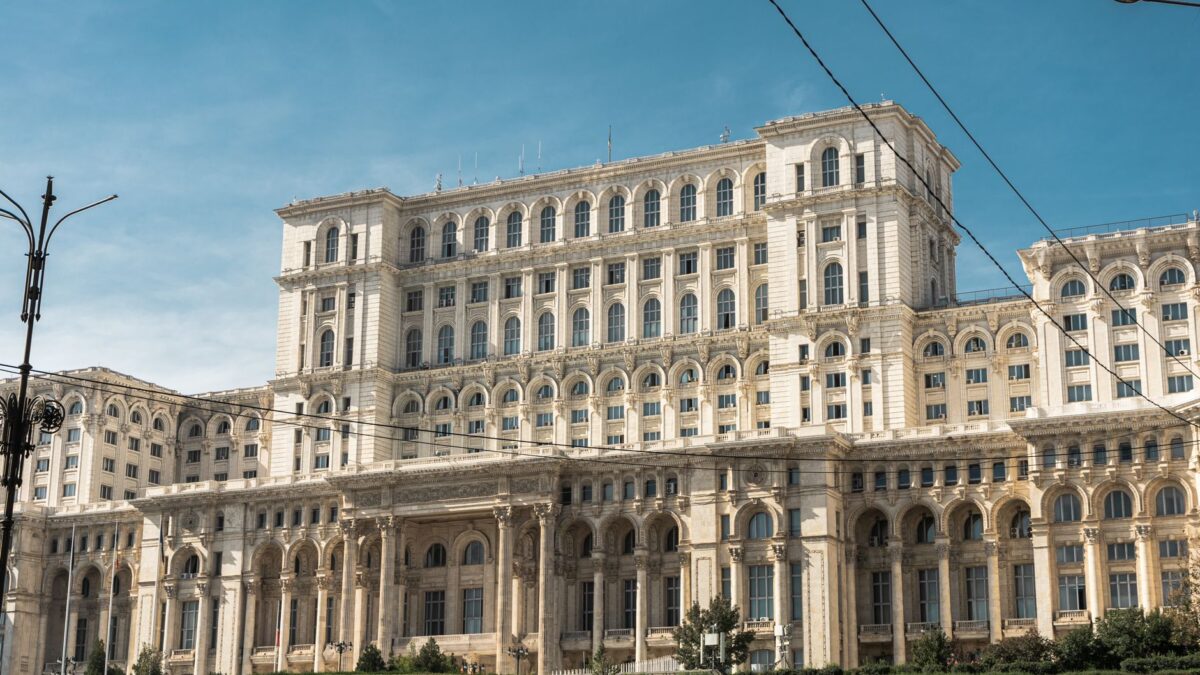 News & Updates
Romania in August 2026: what travelers should know now
Romania in August 2026: Enescu Competition opens, Sector 4 water outage, metro strike risk, ARCAYA festival, and practical tips for your stay in Bucharest.
Eastern Europe
 Poland
Poland Travel Podcast with Kacper Nowak
The flat North European Plain, stretching across central Poland and lacking natural barriers, has shaped centuries of conflict and movement.
 Czechia
Czechia Travel Podcast with Tereza Nováková
From Prague to the Moravian Gate, this show follows one resident learning Czechia's landscapes over seasons, with low mountains and hilly country…
 Hungary
Hungary Travel Podcast with Bence Kovács
Budapest, the capital and largest city, stands on the Duna, one of the two rivers that split Hungary into three regions.
 Bulgaria
Bulgaria Travel Podcast with Georgi Dimitrov
The Balkan Mountains run east-west across Bulgaria, separating the Danubian plain from the Thracian lowlands, and shaping the country's cold winters and…