


Hungary Travel Podcast with Bence Kovács
Hosted by Bence Kovács — a new episode every day from Hungary.
This is a podcast about getting to know Hungary slowly, not ticking off its sights. The country is landlocked, mostly flat or gently rolling, and the Duna and Tisza Rivers cut across it into three broad regions. Travelling here means learning to read plains, hills and water.
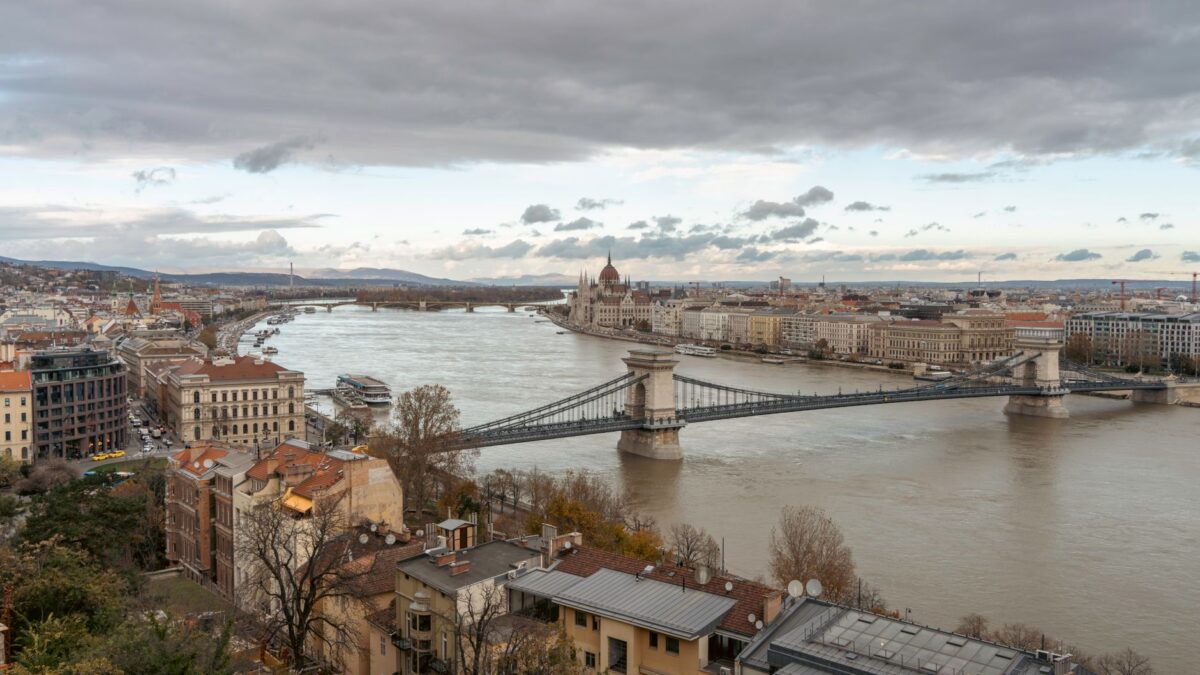
The host covers a deliberately varied range: central Budapest and the Danube Bend, the low mountains on the Slovakian border, the Hortobágy puszta, and the southern city of Szeged on the Tisza. Each place appears with its own logic, not as a list of stops.
The show unfolds by returning to the same places in different seasons, so a quiet village on the Great Plain appears in winter fog and again in summer heat, while Budapest changes with the weather. Knowing the Great Plain properly happens slowly, episode by episode and season by season.
Recent episodes
Things to do in Hungary
 3 Hours Budapest Segway Grand City Tour Buda, Margaret and Pest
 1 Hour Budapest Segway Tour - Parliament Hightails
 Private Sightseeing Tour using Electric Tuk Tuk Ride in Budapest
 Shooting Experience HOLLYWOOD Package in Budapest
 Budapest private sightseeing with Nelli & her local guides
 Hungarian Strudel Making Class: Stretch & Fill Two Ways
 Budapest: Best City Highlights Segway Tour with Local Guide
 Explore Hungary's great wines in an intimate, casual tasting
Plan your trip to Hungary
Getting around
Staying connected
Hungary at a glance
Hungary in depth
Reference data on the country — geography, people, history, economy and transport.
Geography and climate
Location
Central Europe, northwest of Romania
Terrain
Mostly flat to rolling plains; hills and low mountains on the Slovakian border
Climate
Temperate; cold, cloudy, humid winters; warm summers
Elevation
- Highest point
- Kekes 1,014 m
- Lowest point
- Tisza River 78 m
- Mean elevation
- 143 m
Area
- Total
- 93,028 sq km
- Land
- 89,608 sq km
- Water
- 3,420 sq km
Size comparison
Slightly smaller than Virginia; about the same size as Indiana
Coastline
0 km (landlocked)
Land borders
- Total
- 2,106 km
- Border countries
- Austria 321 km; Croatia 348 km; Romania 424 km; Serbia 164 km; Slovakia 627 km; Slovenia 94 km; Ukraine 128 km
Natural resources
Bauxite, coal, natural gas, fertile soils, arable land
Land use
- Agricultural land
- 55.7% (2023 est.)
- Arable land
- 45.4% (2023 est.)
- Permanent crops
- 1.6% (2023 est.)
- Permanent pasture
- 8.6% (2023 est.)
- Forest
- 22.7% (2023 est.)
- Other
- 20.9% (2023 est.)
Note
Landlocked; strategic location on main land routes between Western Europe and Balkan Peninsula, as well as between Ukraine and the Mediterranean basin; the Duna (Danube) and Tisza Rivers divide the country into three large regions
People and society
Population
- Total
- 9,855,745 (2024 est.)
- Male
- 4,812,668
- Female
- 5,043,077
Nationality
- Noun
- Hungarian(s)
- Adjective
- Hungarian
Ethnic groups
Hungarian 84.3%, Romani 2.1%, German 1%, other 1.2%, unspecified 13.7% (2022 est.)
Languages
- Languages
- Hungarian (official) 98.8%, English 25.3%, German 12.6%, Russian 2.1%, French 1.5%, Romanian 1.4%, other 5.1% (2022 est.)
- Major-language sample(s)
- A World Factbook nélkülözhetetlen forrása az alapvető információnak. (Hungarian)
Religions
Catholic 30.1% (Roman Catholic 27.5%, Greek Catholic 1.7%, other Catholic 0.9%), Calvinist 9.8%, Lutheran 1.8%, other Christian (includes Orthodox) 1.6%, other 0.4%, none 16.1%, no answer 40.1% (2022 est.)
Median age
- Total
- 45.1 years (2025 est.)
- Male
- 42.8 years
- Female
- 46.7 years
Life expectancy
- Total population
- 76 years (2024 est.)
- Male
- 72.9 years
- Female
- 79.3 years
Urbanisation
- Urban population
- 72.9% of total population (2023)
- Rate of urbanization
- 0.05% annual rate of change (2020-25 est.)
Where people live
A fairly even distribution throughout most of the country, with urban areas attracting larger and denser populations
Largest cities
1.778 million BUDAPEST (capital) (2023)
Background and government
Background
Hungary became a Christian kingdom in A.D. 1000 and for many centuries served as a bulwark against Ottoman Turkish expansion in Europe. The kingdom eventually became part of the Austro-Hungarian Empire, which collapsed during World War I. The country fell under communist rule after World War II. In 1956, Moscow responded to a Hungarian revolt and announcement of its withdrawal from the Warsaw Pact with a massive military intervention. Under the leadership of Janos KADAR in 1968, Hungary began liberalizing its economy, introducing so-called "Goulash Communism." Hungary held its first multiparty elections in 1990 and initiated a free market economy. It joined NATO in 1999 and the EU five years later.
Government
Parliamentary republic
Capital
Budapest
Time zone
UTC+1 (6 hours ahead of Washington, DC, during Standard Time)
Local name
None
Independence
16 November 1918 (republic proclaimed); notable earlier dates: 25 December 1000 (crowning of King STEPHEN I, traditional founding date); 30 March 1867 (Austro-Hungarian dual monarchy established)
National day
Saint Stephen's Day, 20 August (1083)
Economy and cost of living
Overview
High-income EU and OECD economy; modest recovery from 2024 recession driven by private consumption and moderated inflation; challenges include high fiscal deficits, frozen access to EU funds, and risks from export reliance; implementing tax exemptions, price controls, and mortgage interest caps ahead of 2026 elections
GDP per capita
- Real GDP per capita 2024
- $40,700 (2024 est.)
- Real GDP per capita 2023
- $40,400 (2023 est.)
- Real GDP per capita 2022
- $40,700 (2022 est.)
Inflation
- Inflation rate (consumer prices) 2024
- 3.7% (2024 est.)
- Inflation rate (consumer prices) 2023
- 17.1% (2023 est.)
- Inflation rate (consumer prices) 2022
- 14.6% (2022 est.)
Unemployment
- Unemployment rate 2024
- 4.5% (2024 est.)
- Unemployment rate 2023
- 4.2% (2023 est.)
- Unemployment rate 2022
- 3.7% (2022 est.)
Exchange rate
- Currency
- Forints (HUF) per US dollar -
- Exchange rates 2024
- 365.691 (2024 est.)
- Exchange rates 2023
- 353.088 (2023 est.)
- Exchange rates 2022
- 372.596 (2022 est.)
- Exchange rates 2021
- 303.141 (2021 est.)
- Exchange rates 2020
- 307.997 (2020 est.)
Main industries
Mining, metallurgy, construction materials, processed foods, textiles, chemicals (especially pharmaceuticals), motor vehicles
Agriculture
Maize, wheat, barley, milk, sunflower seeds, sugar beets, rapeseed, apples, pork, grapes (2023)
Transport and connectivity
Airports
109 (2025)
Railways
Total 7,687 km (2020) 3,111 km electrified
Internet domain
.hu
Internet users
Percent of population 92% (2024 est.)
Mobile subscriptions
- Total subscriptions
- 10.2 million (2023 est.)
- Subscriptions per 100 inhabitants
- 104 (2022 est.)
Environment
Environmental issues
Air and soil pollution; water pollution from industry and large-scale agriculture
Fresh water
104 billion cubic meters (2022 est.)
UNESCO Global Geoparks
- Total global geoparks and regional networks
- 4 (2024)
- Global geoparks and regional networks
- Bakony-Balaton; Bukk Region; Hungary; Novohrad-Nógrád (includes Slovakia) (2024)
Country reference figures are periodically revised. Check anything time-sensitive or safety-critical against an official source before you travel.
Hungary travel guides
 News & Updates
Hungary in September 2026: what travelers should know now
Hungary travel update Sept 2026: weather, festivals like the Budapest Wine Festival, transport tips, and local costs in Budapest.
 Food & Drink
What to eat in Hungary — and what it costs
Discover what to eat in Hungary with honest prices for lángos, goulash, and fine dining. A local guide to Budapest's best food spots and…
 Culture & Etiquette
Hungary etiquette: the dos and don’ts
Hungary etiquette: greetings, tipping, dining manners, dress, and small local customs — a practical guide for considerate visitors to Budapest.
 News & Updates
Hungary in August 2026: what travelers should know now
Hungary in August 2026: State Foundation Day, peak-season prices, weather tips, and practical advice from a local. What to know now.
Eastern Europe
 Poland
Poland Travel Podcast with Kacper Nowak
The flat North European Plain, stretching across central Poland and lacking natural barriers, has shaped centuries of conflict and movement.
 Czechia
Czechia Travel Podcast with Tereza Nováková
From Prague to the Moravian Gate, this show follows one resident learning Czechia's landscapes over seasons, with low mountains and hilly country…
 Romania
Romania Travel Podcast with Ioana Popescu
The Eastern Carpathians separate the Transylvanian Basin from the Moldavian Plateau, shaping a central Romania of foggy winters and summer storms.
 Bulgaria
Bulgaria Travel Podcast with Georgi Dimitrov
The Balkan Mountains run east-west across Bulgaria, separating the Danubian plain from the Thracian lowlands, and shaping the country's cold winters and…