

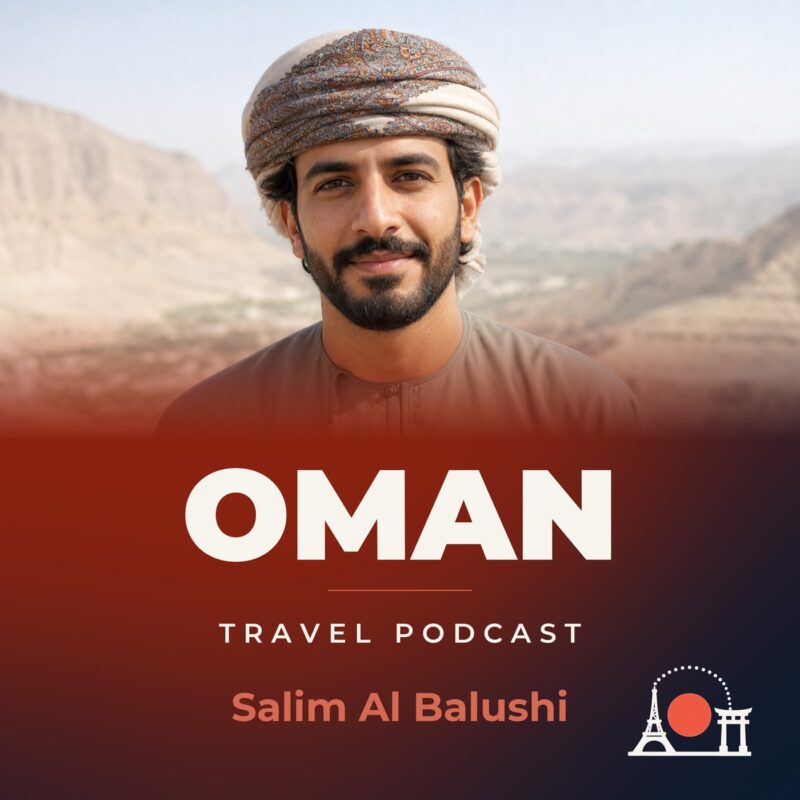
Oman Travel Podcast with Salim Al Balushi
Hosted by Salim Al Balushi — a new episode every day from Oman.
Salim Al Balushi hosts a podcast about travelling through Oman the way a resident would: settling in one place, learning it, then moving somewhere connected to it. Travel here means facing a dry desert interior, humid coasts, and a summer monsoon in the far south that shapes the rhythms of Salalah.
The show ranges from Muscat and the Al Hagar Mountains, where most Omanis live, to the Musandam peninsula above the Strait of Hormuz and the monsoon-soaked hills around Salalah. It also crosses the central desert plain, with its sparse settlements and long routes between water and shade.
The podcast unfolds across seasons rather than as one continuous trip. The host returns to places as the dry season gives way to the khareef in the south, notices how the desert changes after rain, and lets one region lead to the next. That slow accumulation is the point.
Recent episodes
Things to do in Oman
 Private Tour to Wadi Bani Khalid & Wahiba Sand Desert with Sunset
 Private Full-Day Wadi Shab Adventure and Bimmah Sinkhole Tour
 Private Full-Day Wadi Shab and Bimmah Sinkhole Tour
 Sunset in Wahiba Sands 4x4 Adventure
 Nizwa Fort-Nizwa Souq-Birkat Al Mouz-Jebel Akhdar - Private Full Day Tour
 Private Historical Tour - Nizwa Fort - Nizwa Souq - Bahla Fort - Jabreen Castle
 Mountains & Fortresses – Private Day Tour to Nizwa & Jebel Akhdar
 Empty Quarter Desert Sunset tour
Plan your trip to Oman
Getting around
Staying connected
Oman at a glance
Oman in depth
Reference data on the country — geography, people, history, economy and transport.
Geography and climate
Location
Middle East, bordering the Arabian Sea, Gulf of Oman, and Persian Gulf, between Yemen and the UAE
Terrain
Central desert plain, rugged mountains in north and south
Climate
Dry desert; hot, humid along coast; hot, dry interior; strong southwest summer monsoon (May to September) in far south
Elevation
- Highest point
- Jabal Shams 3,004 m
- Lowest point
- Arabian Sea 0 m
- Mean elevation
- 310 m
Area
- Total
- 309,500 sq km
- Land
- 309,500 sq km
- Water
- 0 sq km
Size comparison
Twice the size of Georgia
Coastline
2,092 km
Land borders
- Total
- 1,561 km
- Border countries
- Saudi Arabia 658 km; UAE 609 km; Yemen 294 km
Natural resources
Petroleum, copper, asbestos, some marble, limestone, chromium, gypsum, natural gas
Land use
- Agricultural land
- 4.8% (2023 est.)
- Arable land
- 0.3% (2023 est.)
- Permanent crops
- 0.1% (2023 est.)
- Permanent pasture
- 4.4% (2023 est.)
- Forest
- 0% (2023 est.)
- Other
- 95.2% (2023 est.)
Natural hazards
Summer winds often raise large sandstorms and dust storms in interior; periodic droughts
Note
Consists of Oman proper and two northern exclaves, Musandam and Al Madhah; the former is a peninsula that occupies a strategic location adjacent to the Strait of Hormuz
People and society
Population
- Total
- 3,969,824 (2025 est.)
- Male
- 2,130,080
- Female
- 1,839,744
Nationality
- Noun
- Omani(s)
- Adjective
- Omani
Ethnic groups
Arab, Baluchi, South Asian (Indian, Pakistani, Sri Lankan, Bangladeshi), African
Languages
- Languages
- Arabic (official), English, Baluchi, Swahili, Urdu, Indian dialects
- Major-language sample(s)
- كتاب حقائق العالم، المصدر الذي لا يمكن الاستغناء عنه للمعلومات الأساسية (Arabic)
Religions
Muslim 85.9%, Christian 6.4%, Hindu 5.7%, other and unaffiliated 2% (2020 est.)
Median age
- Total
- 27.5 years (2025 est.)
- Male
- 28.1 years
- Female
- 26.3 years
Life expectancy
- Total population
- 77.4 years (2024 est.)
- Male
- 75.5 years
- Female
- 79.4 years
Urbanisation
- Urban population
- 88.4% of total population (2023)
- Rate of urbanization
- 2.32% annual rate of change (2020-25 est.)
Where people live
The vast majority of the population is located in and around the Al Hagar Mountains in the north; another smaller cluster is found around the city of Salalah in the far south; most of the country remains sparsely populated
Largest cities
1.650 million MUSCAT (capital) (2023)
Background and government
Background
The inhabitants of the area of present-day Oman have long prospered from Indian Ocean trade. In the late 18th century, the nascent sultanate in Muscat signed the first in a series of friendship treaties with Britain. Over time, Oman's dependence on British political and military advisors increased, although the sultanate never became a British colony. In 1970, QABOOS bin Said Al Said overthrew his father and ruled as sultan for the next five decades. His extensive modernization program opened the country to the outside world. He prioritized strategic ties to the UK and US, and his moderate, independent foreign policy allowed Oman to maintain good relations with its neighbors and avoid external entanglements.
In 2011, the popular uprisings that swept the Middle East and North Africa inspired demonstrations in Oman that called for more jobs and economic benefits and an end to corruption. In response, QABOOS implemented economic and political reforms such as granting Oman’s legislative body more power and authorizing direct elections for its lower house. Additionally, the sultan increased unemployment benefits and issued a royal directive mandating a national public- and private-sector job creation plan. As part of the government's efforts to decentralize authority and allow greater citizen participation in local governance, Oman successfully conducted its first municipal council elections in 2012. QABOOS, Oman's longest reigning monarch, died in 2020. His cousin, HAYTHAM bin Tariq Al Said, former Minister of Heritage and Culture, was sworn in as Oman's new sultan the same day.
Government
Absolute monarchy
Capital
Muscat
Time zone
UTC+4 (9 hours ahead of Washington, DC, during Standard Time)
Local name
Saltanat Uman
Independence
1650 (expulsion of the Portuguese)
National day
National Day, 18 November
Economy and cost of living
Overview
High-income, oil-based economy; large welfare system; growing government debt; citizenship-based labor force growth policy; US free trade agreement; diversifying portfolio; high female labor force participation
GDP per capita
- Real GDP per capita 2024
- $36,700 (2024 est.)
- Real GDP per capita 2023
- $37,700 (2023 est.)
- Real GDP per capita 2022
- $39,800 (2022 est.)
Inflation
- Inflation rate (consumer prices) 2023
- 1% (2023 est.)
- Inflation rate (consumer prices) 2022
- 2.5% (2022 est.)
- Inflation rate (consumer prices) 2021
- 1.7% (2021 est.)
Unemployment
- Unemployment rate 2024
- 3.2% (2024 est.)
- Unemployment rate 2023
- 3.2% (2023 est.)
- Unemployment rate 2022
- 3.3% (2022 est.)
Exchange rate
- Currency
- Omani rials (OMR) per US dollar -
- Exchange rates 2024
- 0.384 (2024 est.)
- Exchange rates 2023
- 0.384 (2023 est.)
- Exchange rates 2022
- 0.384 (2022 est.)
- Exchange rates 2021
- 0.384 (2021 est.)
- Exchange rates 2020
- 0.384 (2020 est.)
Main industries
Crude oil production and refining, natural and liquefied natural gas production; construction, cement, copper, steel, chemicals, optic fiber
Agriculture
Vegetables, dates, milk, tomatoes, sorghum, chillies/peppers, goat milk, cucumbers/gherkins, cantaloupes/melons, cabbages (2023)
Transport and connectivity
Airports
37 (2025)
Ports
- Total ports
- 7 (2024)
- Large
- 0
- Medium
- 1
- Small
- 4
- Very small
- 2
- Ports with oil terminals
- 6
- Key ports
- Duqm, Khawr Khasab, Mina Al Fahl, Mina Raysut, Sohar
Internet domain
.om
Internet users
Percent of population 95% (2024 est.)
Mobile subscriptions
- Total subscriptions
- 6.35 million (2024 est.)
- Subscriptions per 100 inhabitants
- 121 (2024 est.)
Environment
Environmental issues
Limited natural freshwater resources; high levels of soil and water salinity in the coastal plains; beach pollution from oil spills; industrial effluents in the water table and aquifers; desertification due to high winds driving desert sand into arable lands
Fresh water
1.4 billion cubic meters (2022 est.)
Country reference figures are periodically revised. Check anything time-sensitive or safety-critical against an official source before you travel.
Oman travel guides
 Costs & Money
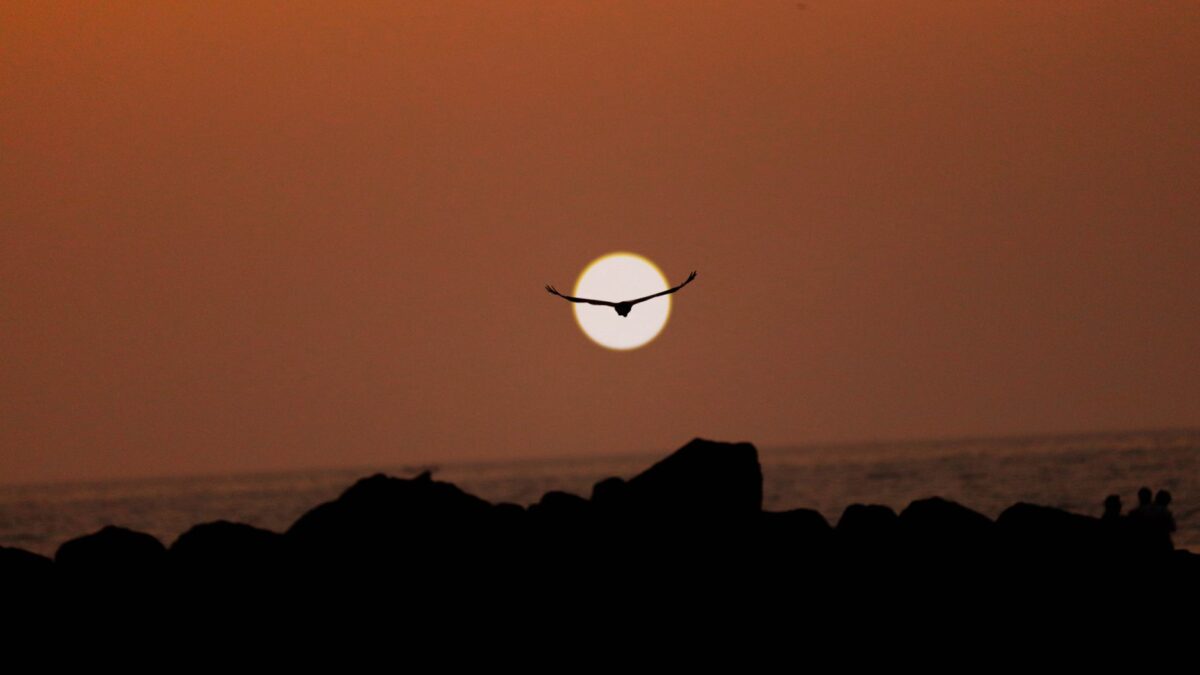
A week in Muscat on a mid-range budget
Plan a week in Muscat on a mid-range budget. Real costs for hotels, food, transport, and attractions in OMR, plus insider tips for September…
 Getting Around
From the airport into Muscat: every option and what it costs
From Mwasalat bus to taxi, Careem, and private transfer—real fares and journey times to get you from Muscat International Airport to anywhere in Oman's…
 Culture & Etiquette
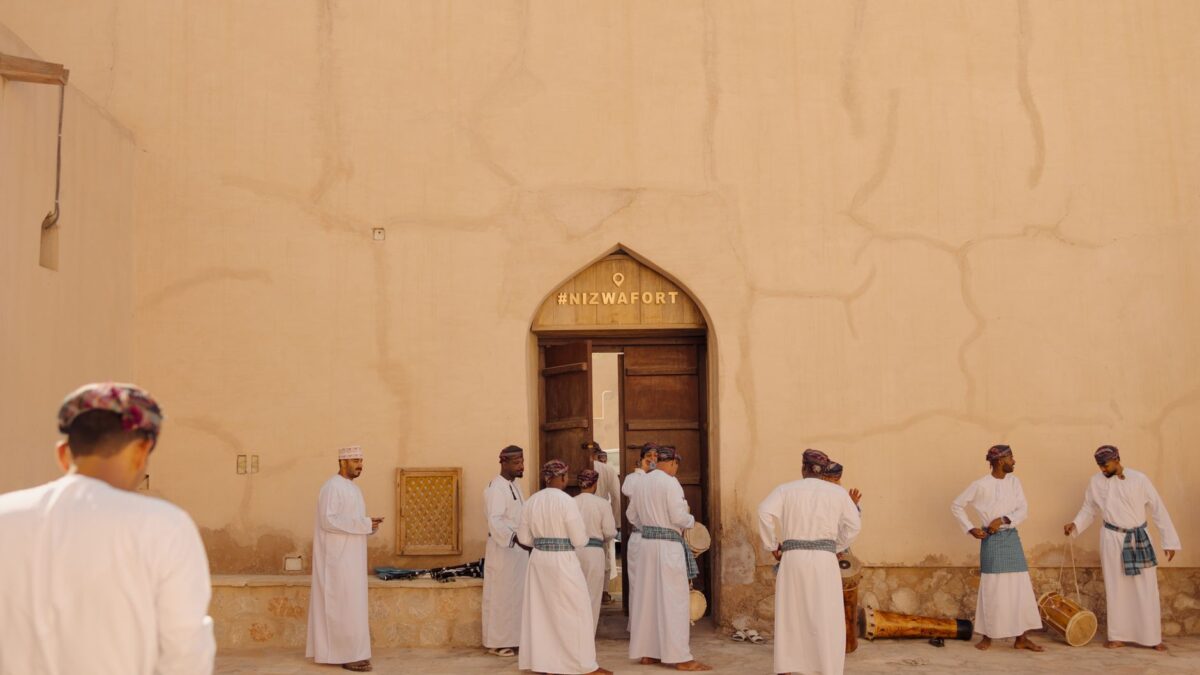
Oman etiquette: the dos and don’ts
Oman etiquette guide: greetings, dress, dining, tipping, and customs in Muscat. Be a considerate visitor with dos and don'ts for Omani culture.
 News & Updates
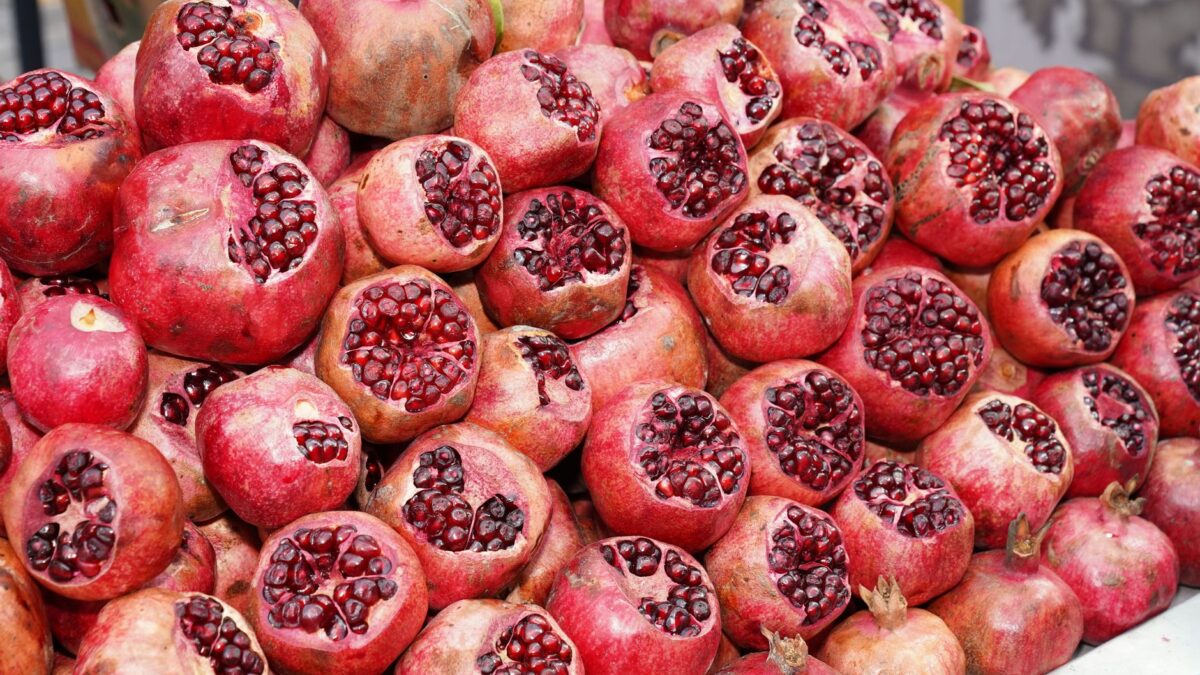
Oman in August 2026: what travelers should know now
Oman in August 2026: heat advisories, Jabal Akhdar pomegranate season, bus cash ban, and cultural events in Muscat. What to know this month.
Western Asia
 Turkey
Turkey Travel Podcast with Emre Yilmaz
The Anatolian plateau, with its harsh interior climate, sits at the heart of a country whose largest city clusters around the Bosporus.
 United Arab Emirates
United Arab Emirates Travel Podcast with Omar Al Mansouri
The eastern Hajar Mountains rise sharply from the flat coastal plain, while the massive sand dunes of the Empty Quarter stretch beyond…
 Saudi Arabia
Saudi Arabia Travel Podcast with Layla Al Qahtani
A mostly sandy desert stretching between the Persian Gulf and the Red Sea makes Saudi Arabia the largest country on earth with…
 Israel
Israel Travel Podcast with Noa Shapira
The Negev desert, hot and dry in the south, gives way to a low coastal plain and central mountains; Hebrew and Arabic…