

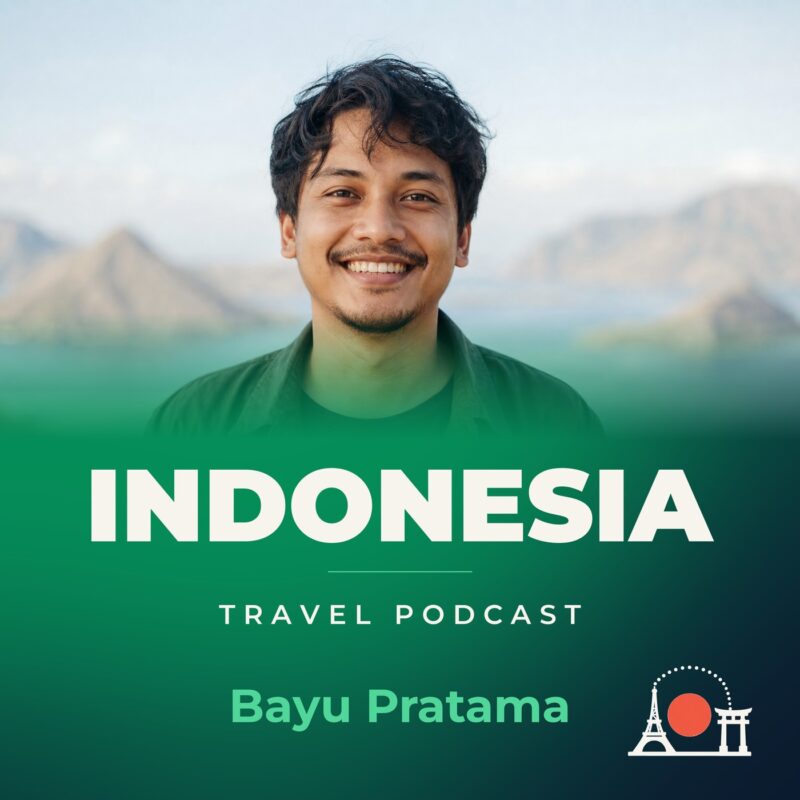
Indonesia Travel Podcast with Bayu Pratama
Hosted by Bayu Pratama — a new episode every day from Indonesia.
Indonesia is an archipelago of more than thirteen thousand islands, with a damp tropical climate and inland mountains that alter the heat. This podcast follows Bayu Pratama as he settles in one place long enough to learn its routines, then moves somewhere connected to it.
The host’s route moves from Jakarta’s crowded coast to the cooler highlands of West Java, then across the Selat Sunda to southern Sumatra and the island’s northeastern shore. He also spends time in Bandung and Surabaya, cities whose daily rhythms rarely make travel headlines. One settled place leads to the next.
As the tropical year turns between wet and dry, he goes back to places from earlier episodes to see what changed. A passing familiarity with a neighbourhood becomes knowledge of its markets, its traffic, its festivals and its quiet days. The show is a slow accumulation of knowing Indonesia properly.
Recent episodes
Things to do in Indonesia
 PRIVATE Authentic Balinese Cooking Class in Ubud at Putu's Home
 Ubud Highlights: Monkey Forest, Rice Terrace, Tirta Empul Temple
 Anggrek Putih Lombok Cooking Class & Garden Tour
 Ubud Adventure All Inclusive Private Day Tour
 Likely to sell out
Nusa Penida Two Dives Trip for Certified Divers
Likely to sell out
Nusa Penida Two Dives Trip for Certified Divers
 Bali Airport Transfer Service in Private
 Best of Ubud Private Tour – All-Inclusive Experience
 ORANGUTAN TREK (2D/1N) by EcoTravel Bukit Lawang
Plan your trip to Indonesia
Getting around
Staying connected
Indonesia at a glance
Indonesia in depth
Reference data on the country — geography, people, history, economy and transport.
Geography and climate
Location
Southeastern Asia, archipelago between the Indian Ocean and the Pacific Ocean
Terrain
Mostly coastal lowlands; larger islands have interior mountains
Climate
Tropical; hot, humid; more moderate in highlands
Elevation
- Highest point
- Puncak Jaya 4,884 m
- Lowest point
- Indian/Pacific Oceans 0 m
- Mean elevation
- 367 m
Area
- Total
- 1,904,569 sq km
- Land
- 1,811,569 sq km
- Water
- 93,000 sq km
Size comparison
Slightly less than three times the size of Texas
Coastline
54,716 km
Land borders
- Total
- 2,958 km
- Border countries
- Malaysia 1,881 km; Papua New Guinea 824 km; Timor-Leste 253 km
Natural resources
Petroleum, tin, natural gas, nickel, timber, bauxite, copper, fertile soils, coal, gold, silver
Land use
- Agricultural land
- 29.1% (2023 est.)
- Arable land
- 9.4% (2023 est.)
- Permanent crops
- 13.9% (2023 est.)
- Permanent pasture
- 5.8% (2023 est.)
- Forest
- 50.6% (2023 est.)
- Other
- 20.3% (2023 est.)
Natural hazards
Occasional floods; severe droughts; tsunamis; earthquakes; volcanoes; forest fires
Volcanism: Indonesia contains the most volcanoes of any country in the world, with over 75 historically active; significant volcanic activity occurs on Java, Sumatra, the Sunda Islands, Halmahera Island, Sulawesi Island, Sangihe Island, and in the Banda Sea; Merapi (2,968 m), Indonesia's most active volcano, has been deemed a Decade Volcano by the International Association of Volcanology and Chemistry of the Earth's Interior, worthy of study due to its explosive history and close proximity to human populations; in 2018, a large explosion and flank collapse destroyed most of the island of Anak Krakatau (Child of Krakatau) and generated a deadly tsunami that left more than 400 dead; other notable historically active volcanoes include Agung, Awu, Karangetang, Krakatau (Krakatoa), Makian, Raung, Sinabung, and Tambora; see note 2 under "Geography - note"
Note
Note 1: 13,466 islands are in the archipelago, of which 922 are permanently inhabited; Indonesia is the world's largest country composed solely of islands; the country straddles the equator and occupies a strategic location along major sea lanes from the Indian Ocean to the Pacific Ocean
Note 2: Indonesia is one of the countries along the Ring of Fire, which is a belt bordering the Pacific Ocean that contains about 75% of the world's volcanoes, up to 90% of the world's earthquakes, and 80% of tsunamis
Note 3: despite having the fourth largest population in the world, Indonesia is the most heavily forested region on earth after the Amazon
People and society
Population
- Total
- 283,587,097 (2025 est.)
- Male
- 141,778,977
- Female
- 141,808,120
Nationality
- Noun
- Indonesian(s)
- Adjective
- Indonesian
Ethnic groups
Javanese 40.1%, Sundanese 15.5%, Malay 3.7%, Batak 3.6%, Madurese 3%, Betawi 2.9%, Minangkabau 2.7%, Buginese 2.7%, Bantenese 2%, Banjarese 1.7%, Balinese 1.7%, Acehnese 1.4%, Dayak 1.4%, Sasak 1.3%, Chinese 1.2%, other 15% (2010 est.)
Languages
- Languages
- Bahasa Indonesia (official, modified form of Malay), English, Dutch, local dialects (of which the most widely spoken is Javanese); note - more than 700 languages are used in Indonesia
- Major-language sample(s)
- Fakta Dunia, sumber informasi dasar yang sangat diperlukan. (Indonesian)
Religions
Muslim 87.4%, Protestant 7.5%, Roman Catholic 3.1%, Hindu 1.7%, other 0.8% (includes Buddhist and Confucian) (2022 est.)
Median age
- Total
- 31.8 years (2025 est.)
- Male
- 30.8 years
- Female
- 32.3 years
Life expectancy
- Total population
- 73.6 years (2024 est.)
- Male
- 71.3 years
- Female
- 76 years
Urbanisation
- Urban population
- 58.6% of total population (2023)
- Rate of urbanization
- 1.99% annual rate of change (2020-25 est.)
Where people live
Major concentration on the island of Java, which is considered one of the most densely populated places on earth; of the outer islands, Sumatra contains some of the most significant clusters, particularly in the south near the Selat Sunda and along the northeastern coast near Medan; the cities of Makasar (Sulawesi), Banjarmasin (Kalimantan) are also heavily populated
Largest cities
11.249 million JAKARTA (capital), 3.729 million Bekasi, 3.044 million Surabaya, 3.041 million Depok, 2.674 million Bandung, 2.514 million Tangerang (2023)
Background and government
Background
The archipelago was once largely under the control of Buddhist and Hindu rulers. By around the 7th century, a Buddhist kingdom arose on Sumatra and expanded into Java and the Malay Peninsula until it was conquered in the late 13th century by the Hindu Majapahit Empire from Java. Majapahit (1290-1527) united most of modern-day Indonesia and Malaysia. Traders introduced Islam around the 11th century, and the religion gradually expanded over the next 500 years. The Portuguese conquered parts of Indonesia in the 16th century, but the Dutch ousted them (except in East Timor) and began colonizing the islands in the early 17th century. It would be the early 20th century before Dutch colonial rule was established across the entirety of what would become the boundaries of the modern Indonesian state.
Japan occupied the islands from 1942 to 1945. Indonesia declared its independence shortly before Japan's surrender, but it required four years of sometimes brutal fighting, intermittent negotiations, and UN mediation before the Netherlands agreed to transfer sovereignty in 1949. A period of sometimes unruly parliamentary democracy ended in 1957 when President SOEKARNO declared martial law and instituted "Guided Democracy." After an abortive coup in 1965 by alleged communist sympathizers, SOEKARNO was gradually eased from power. From 1967 until 1998, President SUHARTO ruled Indonesia with his "New Order" government. After street protests toppled SUHARTO in 1998, free and fair legislative elections took place in 1999 while the country's first direct presidential election occurred in 2004. Indonesia has since become a robust democracy, holding four direct presidential elections, each considered by international observers to have been largely free and fair.
Indonesia is now the world's third-most-populous democracy and the world's largest Muslim-majority nation. It has had strong economic growth since overcoming the Asian financial crisis of the late 1990s. By the 2020s, it had the largest economy in Southeast Asia, and its economy ranked in the world's top 10 in terms of purchasing power parity. It has also made considerable gains in reducing poverty. Although relations amongst its diverse population--there are more than 300 ethnic groups--have been harmonious in the 2000s, there have been areas of sectarian discontent and violence, as well as instances of religious extremism and terrorism. A political settlement to an armed separatist conflict in Aceh was achieved in 2005, but a separatist group in Papua continued to conduct a low-intensity conflict as of 2024.
Government
Presidential republic
Capital
Jakarta
Time zone
UTC+7 (12 hours ahead of Washington, DC, during Standard Time)
Local name
Republik Indonesia
Independence
17 August 1945 (declared independence from the Netherlands)
National day
Independence Day, 17 August (1945)
Economy and cost of living
Overview
Upper middle-income, largest and growing Southeast Asian economy; higher lending rates to moderate inflation; ongoing relocation of capital fueling infrastructure projects; major tourism sector prompting green economy goals
GDP per capita
- Real GDP per capita 2024
- $14,500 (2024 est.)
- Real GDP per capita 2023
- $13,900 (2023 est.)
- Real GDP per capita 2022
- $13,300 (2022 est.)
Inflation
- Inflation rate (consumer prices) 2023
- 3.7% (2023 est.)
- Inflation rate (consumer prices) 2022
- 4.2% (2022 est.)
- Inflation rate (consumer prices) 2021
- 1.6% (2021 est.)
Unemployment
- Unemployment rate 2024
- 3.3% (2024 est.)
- Unemployment rate 2023
- 3.4% (2023 est.)
- Unemployment rate 2022
- 3.5% (2022 est.)
Exchange rate
- Currency
- Indonesian rupiah (IDR) per US dollar -
- Exchange rates 2024
- 15,855.448 (2024 est.)
- Exchange rates 2023
- 15,236.885 (2023 est.)
- Exchange rates 2022
- 14,849.854 (2022 est.)
- Exchange rates 2021
- 14,308.144 (2021 est.)
- Exchange rates 2020
- 14,582.203 (2020 est.)
Main industries
Petroleum and natural gas, textiles, automotive, electrical appliances, apparel, footwear, mining, cement, medical instruments and appliances, handicrafts, chemical fertilizers, plywood, rubber, processed food, jewelry, and tourism
Agriculture
Oil palm fruit, rice, sugarcane, maize, coconuts, cassava, bananas, eggs, chicken, mangoes/guavas (2023)
Transport and connectivity
Airports
556 (2025)
Railways
- Total
- 8,159 km (2014)
- Narrow gauge
- 8,159 km (2014) 1.067-m gauge (565 km electrified)
Ports
- Total ports
- 123 (2024)
- Large
- 3
- Medium
- 6
- Small
- 18
- Very small
- 96
- Ports with oil terminals
- 79
- Key ports
- Belawan, Cilacap, Dumai, Jakarta, Kasim Terminal, Merak Mas Terminal, Palembang, Surabaya, Ujung Pandang
Internet domain
.id
Internet users
Percent of population 69% (2023 est.)
Mobile subscriptions
- Total subscriptions
- 347 million (2024 est.)
- Subscriptions per 100 inhabitants
- 123 (2024 est.)
Environment
Environmental issues
Large-scale deforestation (much of it illegal) and related wildfires cause heavy smog; over-exploitation of marine resources; air pollution from vehicle emissions; waste disposal; water pollution from industrial wastes, sewage
Fresh water
2.019 trillion cubic meters (2022 est.)
UNESCO Global Geoparks
- Total global geoparks and regional networks
- 12 (2025)
- Global geoparks and regional networks
- Batur; Belitong; Ciletuh - Palabuhanratu; Gunung Sewu; Ijen; Kebumen; Maros Pangkep; Merangin Jambi; Meratus; Raja Ampat; Rinjani-Lombok; Toba Caldera (2025)
Country reference figures are periodically revised. Check anything time-sensitive or safety-critical against an official source before you travel.
Indonesia travel guides
 Culture & Etiquette
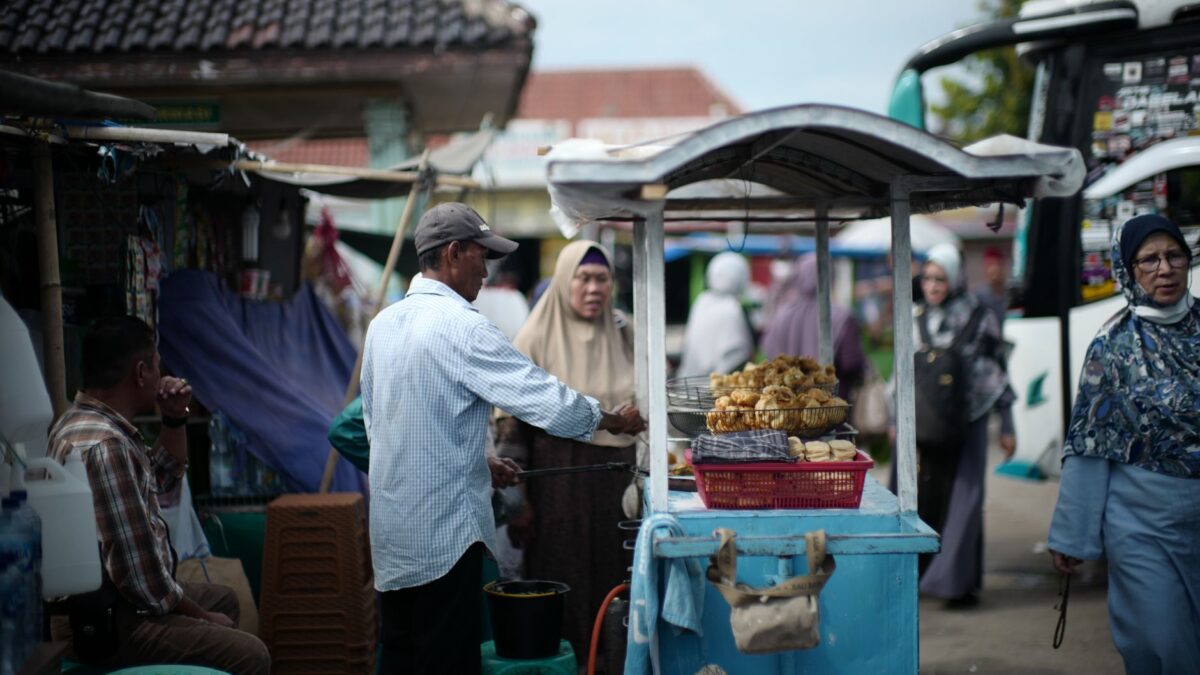
Indonesia etiquette: the dos and don’ts
Master Indonesia etiquette: essential dos and don'ts for greetings, dining, dress, and safety in Jakarta. A local's guide to being a respectful visitor.
 News & Updates
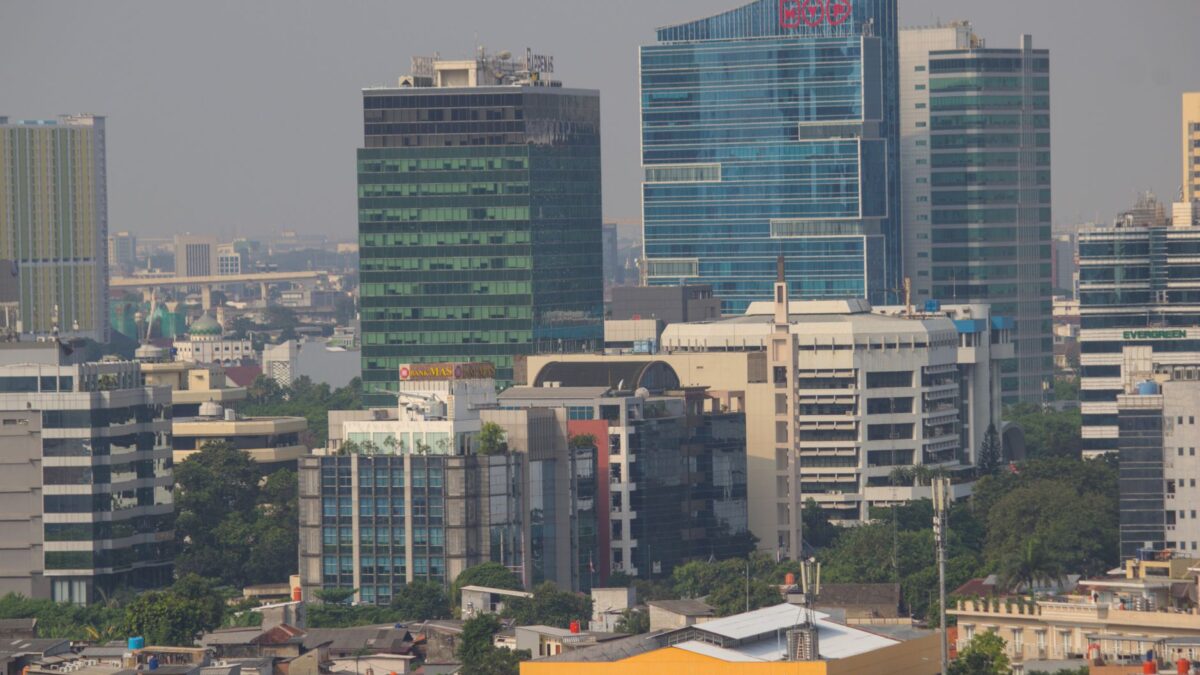
Indonesia in September 2026: what travelers should know now
Jakarta in September 2026: haze, heat, JITEX expo, FLONA flower fest, big concerts, and MRT detours. What travelers need to know right now.
 Getting Around
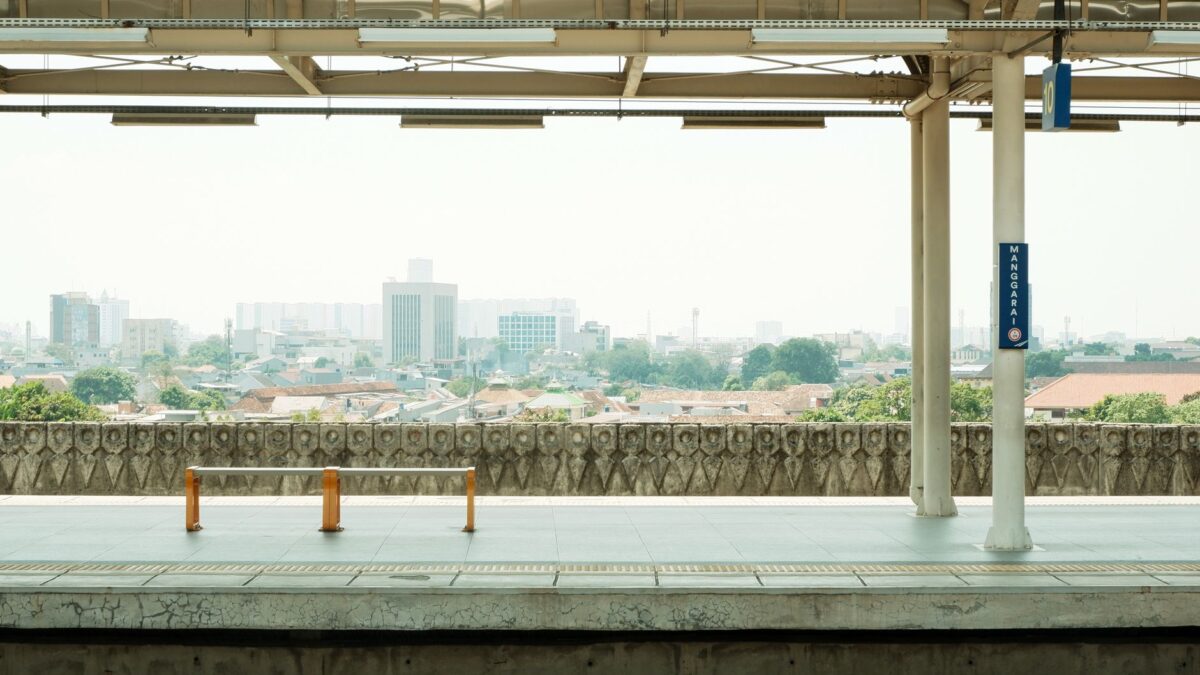
Getting around Jakarta: metros, taxis and passes
Navigate Jakarta like a local: MRT, TransJakarta, KRL, taxis, and ride-hailing. Real fares, the JakLingko card, and when to walk. Inside tips from an…
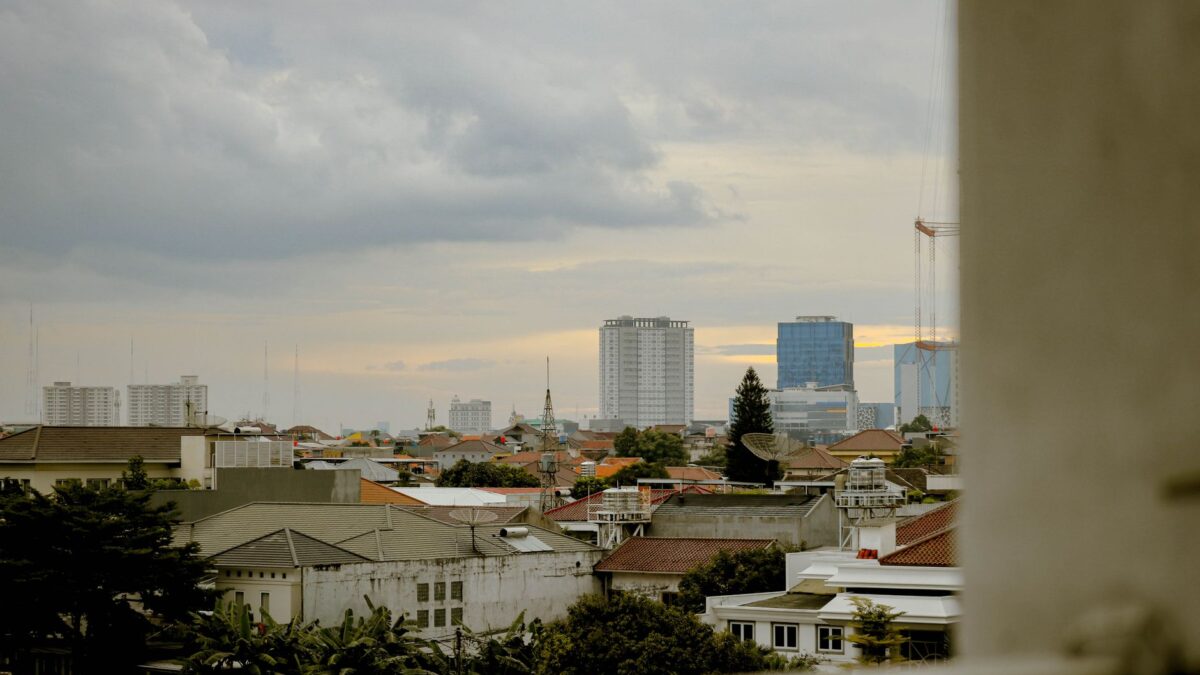 News & Updates
Indonesia in August 2026: what travelers should know now
Jakarta in August 2026: weather, Independence Day leftovers, looming TransJakarta fare hike, cheap eats, and practical tips for your visit.
Southeast Asia
 Thailand
Thailand Travel Podcast with Ploy Siriwan
The southwest monsoon brings rain and cloud from mid-May to September, shaping travel across the central plain and the mountains.
 Vietnam
Vietnam Travel Podcast with Linh Nguyen
The monsoon climate of northern Vietnam brings a hot, rainy season from May to September and a warm, dry season from October…
 Malaysia
Malaysia Travel Podcast with Aisyah Rahman
The Strait of Malacca, separating the Malay Peninsula from Sumatra, has carried maritime trade and cultural influences from China, India, the Middle…
 Singapore
Singapore Travel Podcast with Rachel Tan
The northeastern monsoon, from December to March, brings wet weather that shapes daily life across Singapore's lowlying central plateau and its urbanised…