

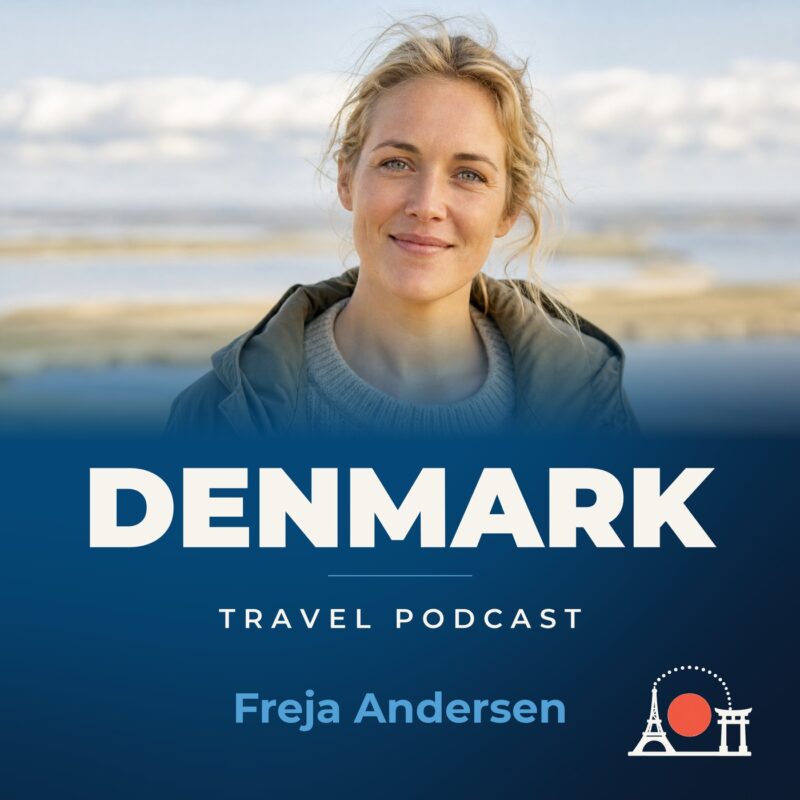
Denmark Travel Podcast with Freja Andersen
Hosted by Freja Andersen — a new episode every day from Denmark.
Denmark Travel Podcast is a resident’s account of travelling through low, windswept landscapes shaped by the North Sea and the Baltic. The country’s flat terrain and scattered islands mean short distances and frequent ferry crossings, so travel here is less about grand journeys than about learning how water, wind and weather order daily life.
Freja ranges across the country rather than hopping between capitals: Copenhagen’s streets, the Limfjorden’s mussel beds, the Wadden Sea’s mudflats and the island of Bornholm in the Baltic. Each episode stays grounded in a particular place and what it reveals about Denmark’s modern, everyday life.
Over two years she settles in one part of Denmark, learns it properly, then moves somewhere connected to it. She comes back to the same coastline in different seasons, watches how the light and wind change, and lets those returns build a fuller picture of the country.
Recent episodes
Things to do in Denmark
 Likely to sell out
Private Copenhagen Boat cruise in Scandinavian mahogany boat
Likely to sell out
Private Copenhagen Boat cruise in Scandinavian mahogany boat
 Sights & Gems: Medieval Copenhagen & Nyhavn with a local host
 Private Copenhagen Boat Tour: Landmarks and Hidden Gems
 Private Copenhagen Family Cargo Bike Tour
 Aarhus City Highlights Tour: History, Culture & Street Art
 2-Hour Private Copenhagen Segway Tour - Your own private group
 The Secret to Danish Happiness: Nørrebro Culture & Fairytales
 3 Hour Extended Copenhagen E-Bike Guided Tour
Plan your trip to Denmark
Getting around
Staying connected
Denmark at a glance
Denmark in depth
Reference data on the country — geography, people, history, economy and transport.
Geography and climate
Location
Northern Europe, bordering the Baltic Sea and the North Sea, on a peninsula north of Germany (Jutland); also includes several major islands (Sjaelland, Fyn, and Bornholm)
Terrain
Low and flat to gently rolling plains
Climate
Temperate; humid and overcast; mild, windy winters and cool summers
Elevation
- Highest point
- Store Mollehoj 171 m
- Lowest point
- Lammefjord -7 m
- Mean elevation
- 34 m
Area
- Total
- 43,094 sq km
- Land
- 42,434 sq km
- Water
- 660 sq km
Size comparison
Slightly less than twice the size of Massachusetts; about two-thirds the size of West Virginia
Coastline
7,314 km
Land borders
- Total
- 141 km
- Border countries
- Germany 140 km; Canada 1.3 km
Natural resources
Petroleum, natural gas, fish, arable land, salt, limestone, chalk, stone, gravel and sand
Land use
- Agricultural land
- 65.5% (2023 est.)
- Arable land
- 59.1% (2023 est.)
- Permanent crops
- 0.7% (2023 est.)
- Permanent pasture
- 5.6% (2023 est.)
- Forest
- 16% (2023 est.)
- Other
- 18.5% (2023 est.)
Natural hazards
Flooding is a threat in some areas of the country (e.g., parts of Jutland, along the southern coast of the island of Lolland) that are protected from the sea by a system of dikes
Note
Composed of the Jutland Peninsula and a group of more than 400 islands (Danish Archipelago); controls Danish Straits (Skagerrak and Kattegat) linking Baltic and North Seas; about one-quarter of the population lives in greater Copenhagen
People and society
Population
- Total
- 6,051,491 (2025 est.)
- Male
- 3,001,698
- Female
- 3,049,793
Nationality
- Noun
- Dane(s)
- Adjective
- Danish
Ethnic groups
Danish (includes Greenlandic (who are predominantly Inuit) and Faroese) 84.2%, Turkish 1.1%, other 14.7% (largest groups are Polish, Romanian, Syrian, Ukrainian, German, and Iraqi) (2023 est.)
Languages
- Languages
- Danish, Faroese, Greenlandic (an Inuit dialect), German (small minority); note - English is the predominant second language
- Major-language sample(s)
- Verdens Faktabog, den uundværlig kilde til grundlæggende oplysninger. (Danish)
Religions
Evangelical Lutheran (official) 71.4%, Muslim 4.3%, other/none/unspecified (denominations include Roman Catholic, Jehovah's Witness, Serbian Orthodox Christian, Jewish, Baptist, Buddhist, Church of Jesus Christ, Pentecostal, and nondenominational Christian) 24.3% (2024 est.)
Median age
- Total
- 42.2 years (2025 est.)
- Male
- 41 years
- Female
- 43.4 years
Life expectancy
- Total population
- 82.1 years (2024 est.)
- Male
- 80.2 years
- Female
- 84.1 years
Urbanisation
- Urban population
- 88.5% of total population (2023)
- Rate of urbanization
- 0.54% annual rate of change (2020-25 est.)
Where people live
Population centers tend to be along coastal areas, particularly in Copenhagen and the eastern side of the country's mainland
Largest cities
1.381 million COPENHAGEN (capital) (2023)
Background and government
Background
Once the seat of Viking raiders and later a major north European power, Denmark has evolved into a modern, prosperous nation that is part of the general political and economic integration of Europe. It joined NATO in 1949 and the EEC (now the EU) in 1973. The country has opted out of certain elements of the EU's Maastricht Treaty, including the European Economic and Monetary Union and justice and home affairs issues. a 2022 referendum resulted in the removal of Denmark's 30-year opt-out on defense issues, now allowing Denmark to participate fully in the EU's Common Security and Defense Policy.
Government
Parliamentary constitutional monarchy
Capital
Copenhagen
Time zone
UTC+1 (6 hours ahead of Washington, DC, during Standard Time)
Local name
Kongeriget Danmark
Independence
Ca. 965 (unified and Christianized under Harald I GORMSSON); 5 June 1849 (became a parliamentary constitutional monarchy)
National day
Constitution Day, 5 June (1849)
Economy and cost of living
Overview
High-income, EU-member, trade-oriented Nordic economy; growth driven by pharmaceuticals, energy, and services; large share of employment in public sector; fixed exchange rate pegged to euro; strong fiscal position and declining public debt; tight labor market mitigated by migrant workers and higher retirement age
GDP per capita
- Real GDP per capita 2024
- $73,700 (2024 est.)
- Real GDP per capita 2023
- $71,500 (2023 est.)
- Real GDP per capita 2022
- $70,200 (2022 est.)
Inflation
- Inflation rate (consumer prices) 2024
- 1.4% (2024 est.)
- Inflation rate (consumer prices) 2023
- 3.3% (2023 est.)
- Inflation rate (consumer prices) 2022
- 7.7% (2022 est.)
Unemployment
- Unemployment rate 2024
- 5.6% (2024 est.)
- Unemployment rate 2023
- 5.1% (2023 est.)
- Unemployment rate 2022
- 4.5% (2022 est.)
Exchange rate
- Currency
- Danish kroner (DKK) per US dollar -
- Exchange rates 2024
- 6.894 (2024 est.)
- Exchange rates 2023
- 6.89 (2023 est.)
- Exchange rates 2022
- 7.076 (2022 est.)
- Exchange rates 2021
- 6.287 (2021 est.)
- Exchange rates 2020
- 6.542 (2020 est.)
Main industries
Wind turbines, pharmaceuticals, medical equipment, shipbuilding and refurbishment, iron, steel, nonferrous metals, chemicals, food processing, machinery and transportation equipment, textiles and clothing, electronics, construction, furniture and other wood products
Agriculture
Milk, wheat, potatoes, barley, sugar beets, pork, rapeseed, rye, oats, chicken (2023)
Transport and connectivity
Airports
102 (2025)
Railways
Total 2,682 km (2020) 876 km electrified
Ports
- Total ports
- 69 (2024)
- Large
- 1
- Medium
- 2
- Small
- 30
- Very small
- 36
- Ports with oil terminals
- 33
- Key ports
- Abenra, Alborg, Arhus, Assens, Augustenborg, Bandholm, Esbjerg, Faborg, Fredericia, Frederikshavn, Haderslev, Holstebro-Stuer, Kalundborg, Kobenhavn, Kolding, Korsor, Marstal, Middelfart, Naestved, Nakskov, Nyborg, Nykobing, Odense, Randers, Ronne, Rudkobing, Sakskobing, Skagen Havn, Sonderborg, Stubbekobing, Studstrup, Svendborg, Vejle
Internet domain
.dk
Internet users
Percent of population 100% (2024 est.)
Mobile subscriptions
- Total subscriptions
- 7.57 million (2024 est.)
- Subscriptions per 100 inhabitants
- 127 (2024 est.)
Environment
Environmental issues
Air pollution, principally from vehicle and power-plant emissions; nitrogen and phosphorus pollution of the North Sea; water pollution from animal wastes and pesticides
Fresh water
6 billion cubic meters (2022 est.)
UNESCO Global Geoparks
- Total global geoparks and regional networks
- 3 (2024)
- Global geoparks and regional networks
- Odsherred; South Fyn Archipelago; Vestjylland (2024)
Country reference figures are periodically revised. Check anything time-sensitive or safety-critical against an official source before you travel.
Denmark travel guides
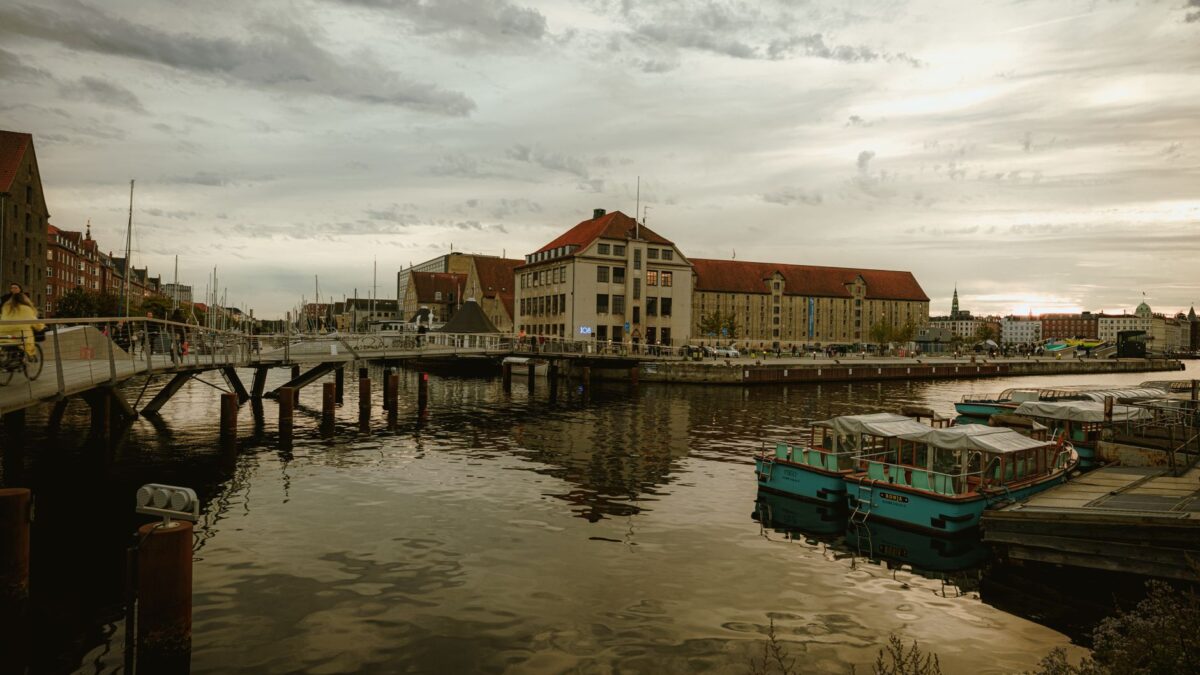 News & Updates
Denmark in September 2026: what travelers should know now
Denmark in September 2026: Weather, festivals, costs, and essential travel tips for Copenhagen's early autumn season.
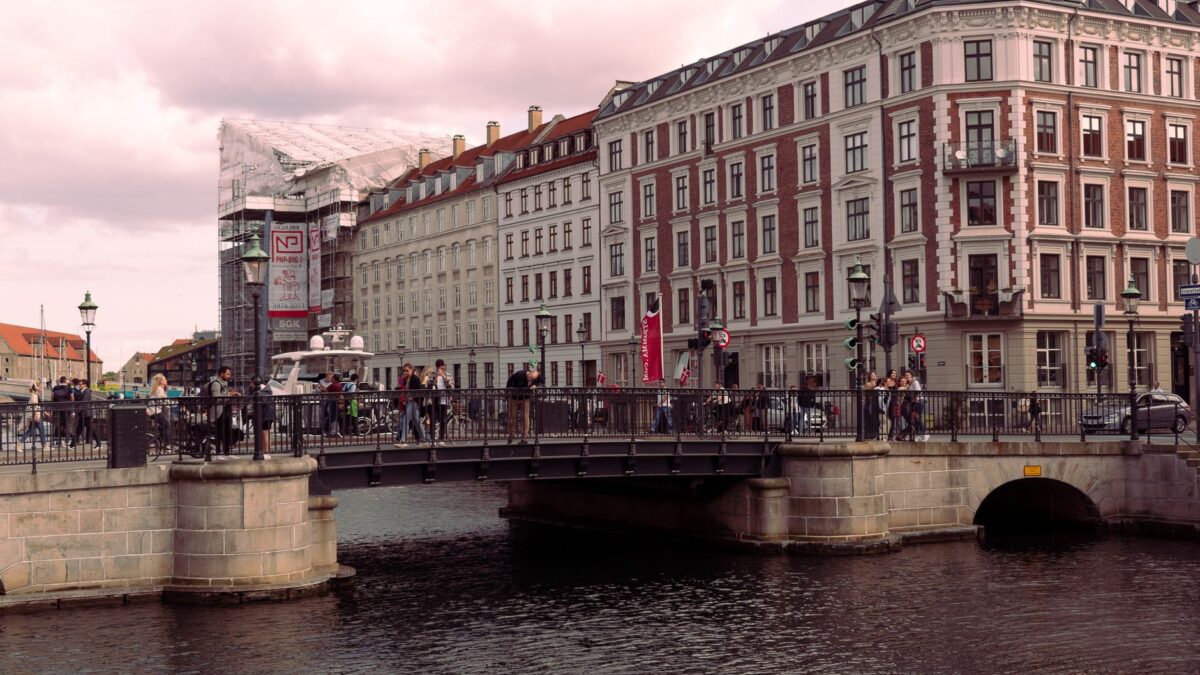 News & Updates
Denmark in August 2026: what travelers should know now
Copenhagen in August 2026: weather, seasonal crowds, budget eats, transit tips, and local insights for your Denmark trip this month.
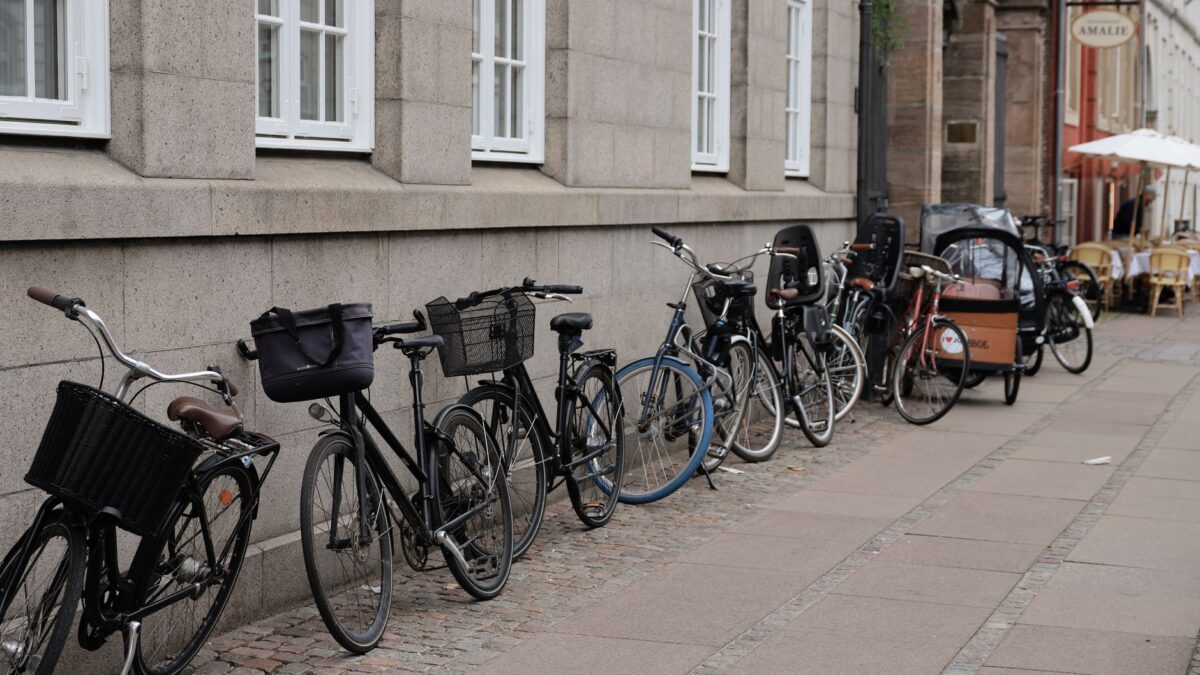 Travel Tips
A first-timer’s guide to Denmark
Plan your first trip to Denmark with this practical guide: best time to visit, costs in kroner, getting around, and insider tips for Copenhagen…
Northern Europe
 United Kingdom
United Kingdom Travel Podcast with Oliver Hughes
The Scottish lowlands between Edinburgh and Glasgow sit under overcast skies brought by the North Atlantic Current and prevailing southwest winds.
 Ireland
Ireland Travel Podcast with Saoirse Byrne
The western seaboard's sea cliffs face the North Atlantic, while over 40% of the population lives within 100 km of Dublin.
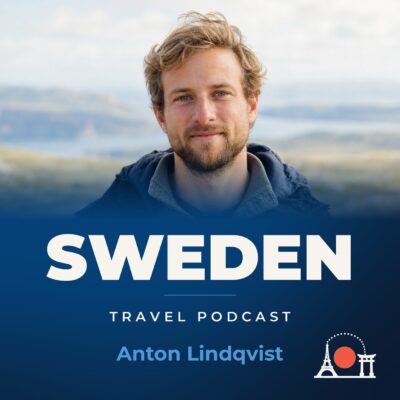 Sweden
Sweden Travel Podcast with Anton Lindqvist
The Baltic coast holds most of Sweden's population clusters, while the interior north remains sparsely populated and subarctic, and the Danish Straits…
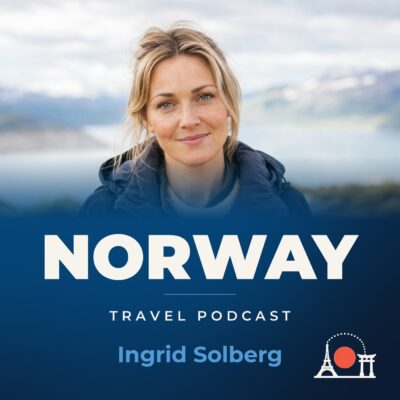 Norway
Norway Travel Podcast with Ingrid Solberg
A listener gains a resident's perspective on Norway's high plateaus, deep fjords and arctic tundra, learned by living in one place at…